What is ISO 27031?

ISO/IEC 27031:2025 provides a structured approach to ensuring that information and communication technology (ICT) systems are prepared to support business continuity during disruptive events. This standard outlines the methods and requirements for developing, implementing, and maintaining ICT readiness within an organization’s business continuity management framework.
By following ISO/IEC 27031, organizations can ensure their ICT systems are resilient, support recovery objectives, and maintain critical business operations when incidents like cyberattacks or system failures occur.
To begin aligning your ICT continuity with ISO/IEC 27031, contact us at support@pacificcert.com
Purpose
The purpose of ISO/IEC 27031:2025 is to offer a structured approach for preparing, maintaining, and recovering ICT services that are vital to business operations. Rather than focusing only on security controls or infrastructure resilience, it emphasizes the continuity of technology-based processes that support daily activities. The standard helps organizations develop frameworks that balance technological capability with business demands, ensuring that core services can function even during adverse events. It also aims to align ICT continuity planning with organizational risk tolerance, making business continuity a shared responsibility between IT teams and executive leadership.

This guidance is critical in today’s landscape, where even brief outages in communication, data access, or processing can result in lost revenue, legal exposure, and reputational harm.
Scope and Applicability
ISO/IEC 27031 applies to any organization that depends on ICT systems to deliver products, services, or internal functions. The standard is not limited by size, industry, or region—it is relevant to global enterprises, small businesses, government bodies, and nonprofit organizations alike. It is especially valuable in sectors where downtime can disrupt critical functions, such as finance, healthcare, logistics, telecommunications, and energy.
Organizations operating in cloud-native environments, hybrid networks, or across distributed teams will benefit greatly from this standard’s detailed guidance on ICT resilience. Additionally, those already implementing ISO/IEC 27001 or ISO 22301 can use ISO/IEC 27031 to deepen their capabilities around IT recovery and maintain compliance during audits or client reviews.
Key Definitions
- ICT Readiness: The state of being prepared to maintain and restore ICT services during and after a disruption.
- BCM (Business Continuity Management): A process that ensures essential business operations continue during and after disruption.
- Recovery Time Objective (RTO): The acceptable downtime before ICT functions must be restored.
- Disruptive Incident: Any event, planned or unplanned, that interrupts normal ICT services.
Clause-wise structure of ISO 27031
Clause | Title |
| Description |
1 | Scope | Defines the boundaries and intent of ICT readiness for business continuity. | |
2 | Normative References | Cites supporting standards, including ISO 22301 and ISO/IEC 27001. | |
3 | Terms and Definitions | Clarifies key terms used throughout the standard. | |
4 | Principles of ICT Readiness | Outlines foundational concepts like risk-based approach and continuity planning. | |
5 | Planning and Implementation | Guides organizations in designing and deploying ICT readiness frameworks. | |
6 | Monitoring and Evaluation | Covers metrics, testing, and regular review of readiness capabilities. | |
7 | Integration with BCM and ISMS | Advises on aligning ICT readiness with broader continuity and security systems. |
What are the requirements of ISO 27031?
Before listing the specific requirements, it’s important to understand that ISO/IEC 27031 helps organizations structure their ICT environments to support resilient operations. It emphasizes ongoing risk evaluation, recovery design, and integration with business continuity efforts.
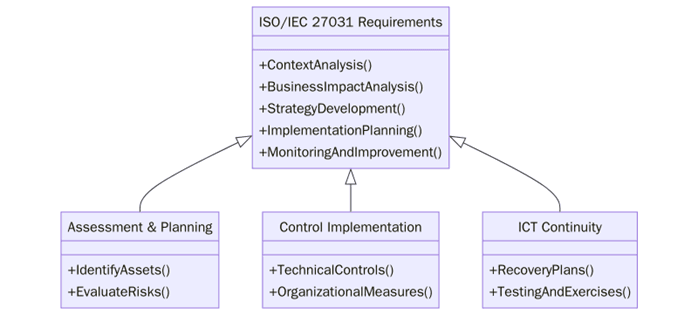
- Define ICT services critical to the continuity of business processes.
- Identify and assess potential risks that could disrupt these services.
- Set recovery objectives (RTOs and RPOs) based on business needs.
- Implement ICT continuity strategies like data backup, redundancy, and failover systems.
- Maintain accurate documentation and configuration details for ICT components.
- Develop a structured testing and validation process to ensure readiness.
- Establish communication protocols for internal teams and external partners.
- Ensure all systems and strategies are regularly reviewed and updated.
For more information, contact us at support@pacificcert.com.
ISO 27031 Certification Audit Checklist
Since ISO/IEC 27031 is a guidance standard and not certifiable on its own, audits focus on the maturity and alignment of IRBC within your overall BCMS:
- Have cloud roles and responsibilities between the provider and customer been clearly defined and documented?
- Is virtual machine configuration securely managed and isolated in multi-tenant cloud environments?
- Are procedures in place for the secure return, deletion, or migration of customer assets after contract termination?
- Is administrative access by cloud service customers properly controlled and monitored by the provider?
- Are cloud-specific security requirements addressed in the service agreement (data location, jurisdiction etc.)?
- Is customer activity within the cloud environment logged, monitored, and reviewed for anomalies?
- Are customers informed of any changes that may affect cloud service security controls or SLAs?
- Are measures implemented to segregate and protect customer data in shared infrastructure setups?
- Is there a documented process for handling cloud-specific incidents and notifying affected parties?
What are the benefits of ISO 27031 Certification?
By implementing ISO/IEC 27031, organizations not only reduce the impact of IT disruptions but also build a more secure and trustworthy business environment. The benefits include:
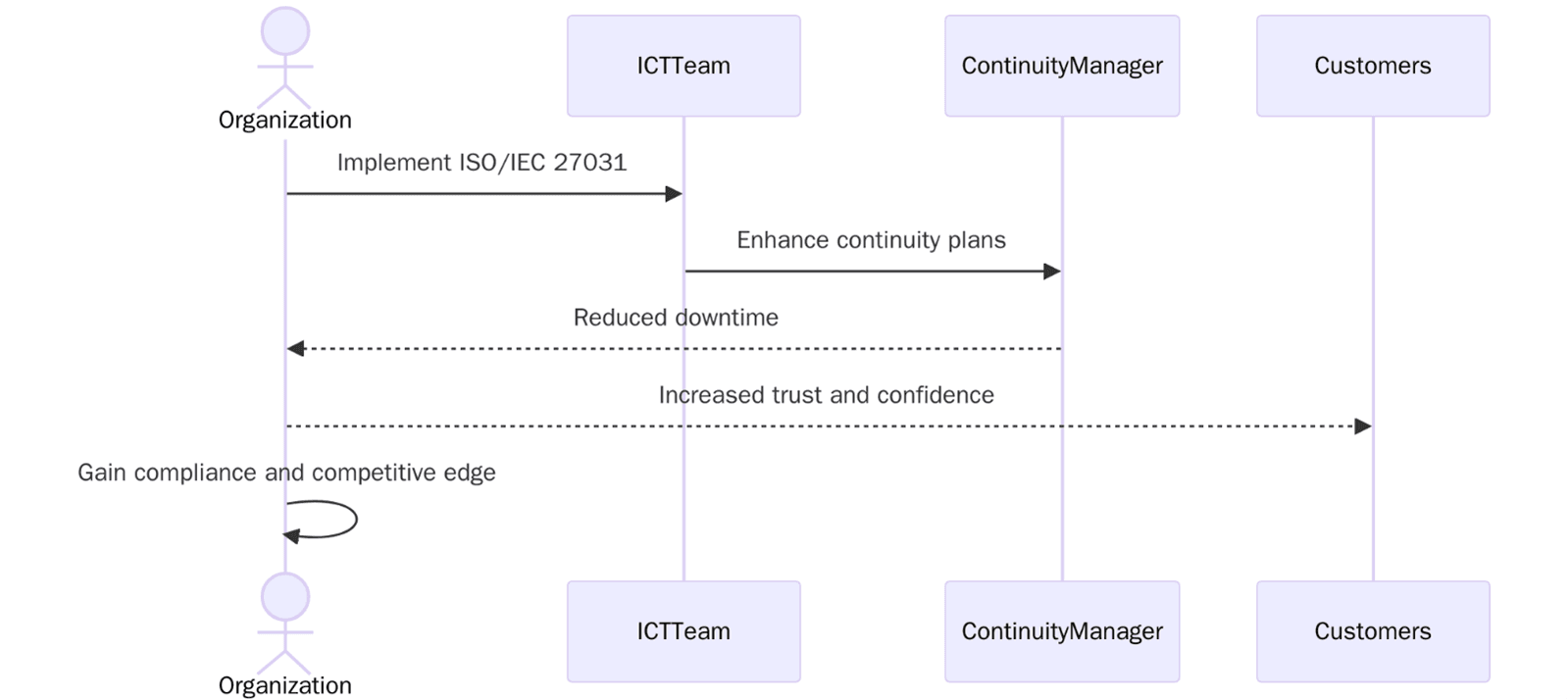
- Faster system recovery during outages with clear recovery objectives and plans
- Reduced financial loss by limiting the duration and scope of ICT interruptions
- Greater trust from customers, partners, and stakeholders due to proven continuity capabilities
- Improved risk visibility through structured evaluation of ICT vulnerabilities
- Integration readiness with business continuity (ISO 22301) and information security (ISO/IEC 27001)
- Stronger preparedness through regular testing, monitoring, and plan reviews
In recent years, demand for ICT continuity frameworks will continue to rise across cloud-first and digitally integrated organizations. Businesses globally are recognizing the growing dependency on ICT services and are investing in ISO-aligned frameworks to support uninterrupted operations during cyber incidents, system crashes or natural disasters. ISO/IEC 27031 is increasingly being adopted by data centres, financial institutions and public infrastructure sectors as part of their resilience strategies.
Certification Process for ISO/IEC 27031
Although ISO/IEC 27031 is not independently certifiable, implementation typically involves:
- Gap Assessment: Analyse current ICT continuity practices.
- Implementation: Develop ICT readiness plans based on identified gaps.
- Integration: Align ICT controls with ISO 27001 or 22301 management systems.
- Documentation Review: Prepare relevant policies, testing logs, and recovery objectives.
- Audit: Undergo certification audit under ISO/IEC 27001 or ISO 22301.
- Certification Issuance: If successful, certification body grants a certificate for the integrated system.
Timeline
Implementation typically occurs in parallel with or following ISO/IEC 22301 adoption. The timeline for certification involves several phases. Preparation takes1-2 months for assessment, documentation gathering, and implementation of security measures. Audit takes another 1-2 months for the auditing process. Certification usually happens in 1 month after the audit. Ongoing Surveillance are the Annual audits to ensure continued compliance. Overall readiness usually achieved within 3–6 months, depending on organizational complexity and resource availability.
Cost of ISO 27031 Implementation
The cost of ISO 27031 certification varies based on factors such as the size of the pipeline system, its complexity, and the number of facilities involved. Costs include Audit Fee which is the Fee for the certification body’s audit process. Training costs are the costs for educating staff on GDP Certification and the necessary processes for compliance. Ongoing maintenance are the costs for regular audits and recertification required every 3 years.
There is no separate certification fee as ISO/IEC 27031 is not a standalone certifiable standard.
How Pacific Certifications Can Help?
Pacific Certifications offers audit and assurance services aligned with ISO/IEC 22301 and integrated ICT readiness frameworks based on ISO/IEC 27031. Our services include:
- Gap assessments for IRBC alignment
- Verification of BIA, RTO/RPO and ICT strategy tiers
- Review of governance structures and incident integration
- Joint audits combining ISO/IEC 22301 and ICT readiness elements
- Documentation and planning review support
Get in touch at support@pacificcert.com to align your ICT continuity planning with global best practices.
ISO 27031 Training and Courses
Various training courses are available to support compliance and implementation of ISO/IEC 27031:
- Lead Auditor Training – Equips professionals to conduct external third-party audits.
- Lead Implementer Training – For those responsible for planning and executing ISO/IEC 27031 implementation.
- Internal Auditor Training – Preparing internal auditors for certification audits
Pacific Certifications offers accredited courses for organizations seeking ISO/IEC 27031 -related training. For training schedules and enrolment, contact support@pacificcert.com.
Frequently Asked Questions (FAQs)
Is ISO 27031 certifiable on its own?
No, It is a guidance standard and is not certifiable independently. It complements ISO/IEC 22301 for ICT readiness.
Who should adopt ISO 27031?
Organizations that depend on ICT services for critical operations and need structured continuity planning—such as banks, telecommunication firms, healthcare providers and data centres.
How does it relate to ISO/IEC 22301 and ISO/IEC 27001?
ISO/IEC 27031 focuses on ICT readiness and disaster recovery, while ISO/IEC 22301 addresses broader business continuity and ISO/IEC 27001 covers information security governance.
How often should IRBC plans be reviewed or tested?
At least annually, or after significant changes in infrastructure, business requirements, or threat landscape.
Does the standard address cloud or third-party dependencies?
Yes. The updated guidance explicitly includes considerations for cloud and external supplier dependencies in continuity planning.
Ready to get ISO 27031 certified?
Contact Pacific Certifications to begin your certification journey today!
Suggested Certifications –
Read more: Pacific Blogs