Data breaches, cyber threats, and information security failures are among the most significant risks facing organisations today. ISO 27001 certification demonstrates that your Information Security Management System has been independently audited and verified against the world’s leading information security standard, giving your customers, partners, and regulators the assurance that the data they trust you with is protected by a proven, structured system.
ISO 27001 is the internationally recognised standard for Information Security Management Systems (ISMS), developed by the International Organization for Standardization and the International Electrotechnical Commission. It provides organisations with a structured framework to identify, manage, and continuously improve the security of their information assets, covering everything from data protection and access controls to cyber risk management, incident response, and business continuity.
The current version, ISO 27001:2022, introduced significant updates to the standard, including a restructured set of information security controls, new controls addressing cloud security, threat intelligence, data masking, and secure coding, and a stronger emphasis on managing information security risks across the supply chain. It replaced ISO 27001:2013 and represents the most comprehensive update to the standard in nearly a decade. ISO 27001 applies to any organisation that handles information, which in practice means every organisation. Whether you are a technology company, financial services provider, healthcare organisation, government body, or professional services firm, the standard scales to fit the nature and complexity of your information security environment.
ISO 27001 is the world’s most widely adopted information security standard and an increasingly common requirement in client contracts, regulatory frameworks, and supply chain approvals worldwide.
Get in touch with Pacific Certifications today for a seamless, transparent path to accredited registration. Our global experts are available 24/7 to support your operational needs.
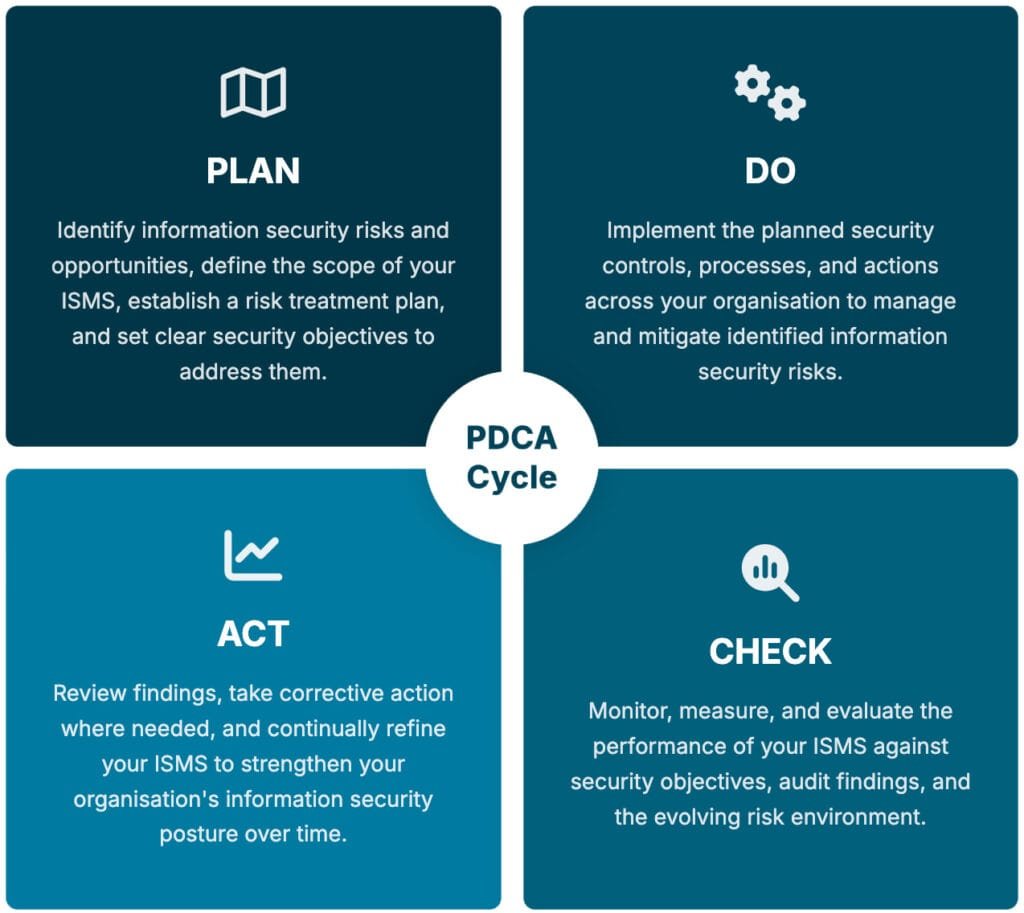
The PDCA (Plan-Do-Check-Act) cycle is the operational foundation of ISO 27001, providing a structured approach to managing information security risks and driving continual improvement. It ensures your Information Security Management System remains proactive, adaptive, and effective in the face of an ever-evolving threat landscape.
From initial assessment to certified status, our expert auditors guide you through every stage with precision, transparency, and globally recognised accreditation.
Receive an independently audited, globally recognised ISO 27001 certificate through our clear, structured two-stage audit process.
Equip your teams with the knowledge and skills needed to implement and maintain an effective Information Security Management System, from awareness through to lead auditor level.
Already certified to ISO 9001, ISO 14001, or ISO 45001? We combine your information security audit with existing certifications into a single, efficient programme that saves time and reduces disruption.
Before your formal audit, review your current information security practices internally against ISO 27001 requirements to identify and close any gaps in advance.
ISO 27001 has evolved across two versions, reflecting how organisations are expected to manage information security in an increasingly complex and threat-driven digital environment.
| Parameter | ISO 27001:2013 | ISO 27001:2022 |
|---|---|---|
| Structural Template | 14 control domains with 114 individual security controls. | Streamlined to 4 control themes with 93 controls, making the standard easier to implement and audit. |
| New Controls | No specific controls for cloud security, threat intelligence, or secure coding. | 11 new controls introduced covering cloud services, threat intelligence, data masking, secure coding, and ICT readiness for business continuity. |
| Risk Approach | Risk-based thinking applied to information security planning and treatment. | Stronger emphasis on proactive threat intelligence and information security risk management across the supply chain. |
| Governance | Management commitment and designated information security roles required. | Direct top management accountability with clearer expectations around information security objectives and organisational roles. |
| Documentation | Mandatory documented procedures and records across all control domains. | Flexible, outcome-focused documentation aligned to organisational context and risk profile. |
| Focus Area | Confidentiality, integrity, and availability of information assets. | Cyber resilience, cloud security, supply chain information security, and alignment with modern digital risk frameworks. |
Ensuring sensitive information is accessible only to those who are authorised, protected through access controls, encryption, and data masking.
Maintaining the accuracy and completeness of information at all times, through version control, data validation, and change management.
Guaranteeing that information is accessible to authorised users when they need it, supported by redundancy, disaster recovery planning, and regular backups.
ISO 27001:2022 follows a 10-clause framework, with Clauses 4 through 10 defining the formal requirements assessed during certification, supported by Annex A controls.
| Clause | Title | Scope & Requirement Objective |
|---|---|---|
| Clause 4 | Context of the Organisation | Identify internal and external factors affecting information security, understand stakeholder needs, and define the scope of your ISMS. |
| Clause 5 | Leadership | Top management must demonstrate active commitment, establish an information security policy, and assign clear roles and responsibilities. |
| Clause 6 | Planning | Identify information security risks and opportunities, define a risk treatment plan, and set measurable information security objectives. |
| Clause 7 | Support | Ensure adequate resources, competence, awareness, communication, and control of documented information across the organisation. |
| Clause 8 | Operation | Implement and control the processes needed to manage information security risks and meet the requirements of your risk treatment plan. |
| Clause 9 | Performance Evaluation | Monitor and measure ISMS performance, conduct internal audits, and carry out management reviews against set security objectives. |
| Clause 10 | Improvement | Address non-conformities, implement corrective actions, and drive continual improvement of information security performance and the ISMS. |
| Annex A | Information Security Controls | 93 controls across 4 themes covering organisational, people, physical, and technological security measures to support risk treatment. |
Everything you need to prepare for ISO 27001 certification (pdf) in one place.
The path to certification balances system building with rigorous auditing.
Before the formal audit begins, review your existing information security practices internally against ISO 27001 requirements to identify and address any gaps.
A documentation review to confirm your ISMS is adequately developed, your risk assessment is complete, and your system is ready for the on-site assessment.
Our auditor evaluates whether your ISMS is fully implemented, operational, and effective across your organisation, including a review of your Annex A controls.
Annual surveillance audits maintain your certification, followed by full recertification at the end of the three-year cycle.
| Week | Activity | Core Milestones & Focus Areas |
|---|---|---|
| Week 1 | Application & Scoping | Submit your application and define the scope of your Information Security Management System. |
| Week 2 | Gap Analysis | Internally review existing information security practices and controls against ISO 27001 requirements. |
| Weeks 3-4 | ISMS Implementation | Deploy security controls, complete your risk assessment and treatment plan, and ensure documented information is in place. |
| Weeks 5-6 | Stage 1 Audit | Our auditor reviews your ISMS documentation, risk assessment, and Statement of Applicability to confirm readiness for the main assessment. |
| Weeks 7-8 | Stage 2 Audit | Full on-site or remote evaluation of your ISMS implementation, control effectiveness, and overall information security posture. |
| Week 9 | Technical Review | Address any findings, close non-conformities, and finalise the certification review. |
| Week 10 | Certificate Issuance | Receive your accredited ISO 27001 certificate upon successful completion of the assessment. |
Note: The timeline provided is tentative and may vary depending on factors such as the organization’s size, scope, number of locations, documentation readiness, availability of personnel, assessment findings, and completion of corrective actions.
ISO 27001 certification cost vary depending on your organisation’s size, number of locations, industry, and the complexity of your information security environment and asset landscape. If you are integrating ISO 27001 with other ISO standards such as ISO 9001 or ISO 45001 under a single audit programme, this can also influence the overall cost.
At Pacific Certifications, we offer transparent, competitive pricing with no hidden charges. Contact us for a tailored quote or use our free cost calculator to get an instant estimate.
Cyber threats are more frequent, more sophisticated, and more damaging than at any point in history. In 2026, organisations that cannot demonstrate a structured, independently verified approach to information security are not just at risk of a breach, they are at risk of losing clients, contracts, and regulatory standing. ISO 27001 certification gives your organisation the credibility to prove that information security is managed as a system, not handled as an afterthought.
Data protection regulations are tightening globally, supply chains are demanding verified security credentials from their vendors, and customers are increasingly making purchasing decisions based on how seriously an organisation takes the protection of their data. ISO 27001 certification addresses all of these pressures in one accredited, internationally recognised framework.
We provide deep, sector-specific auditing aligned directly with your daily operations.
Upskill your internal teams with our certified training pathways.
For professionals looking to conduct and lead ISO 27001 audits with confidence and internationally recognised credentials.
For those responsible for designing, implementing, and maintaining an Information Security Management System within their organisation.
Training For teams and individuals who need a clear, practical understanding of ISO 27001 and what it means for information security in their day-to-day work.
We are not just a certification body, we are the partner that helps your organisation earn trust, improve performance, and grow with confidence.
Accredited by the ABIS (Accreditation Board for International Standards), our certificates are accepted by clients, regulators, and procurement bodies worldwide.
Our auditors bring sector-specific knowledge to every engagement, ensuring your audit is relevant, thorough, and conducted by someone who understands your business.
We operate globally with the capability to conduct both remote and on-site audits, delivering consistent, high-quality certification services wherever you are.
From your first enquiry to your final certificate, we keep things clear, efficient, and tailored to your organisation — no unnecessary delays, no hidden costs.
ISO 27001 certification is independent, third-party confirmation that your organisation has a structured Information Security Management System that meets the requirements of the internationally recognised ISO 27001 standard. It demonstrates to clients, regulators, and supply chain partners that the information you handle is protected by a verified, audited, and continuously improved security framework.
ISO 27001:2022 is the current version of the standard and introduced significant updates including a restructured control set reduced from 114 to 93 controls, 11 new controls covering cloud security, threat intelligence, data masking, and secure coding, and stronger expectations around supply chain information security. Organisations still certified under ISO 27001:2013 should have already transitioned to the 2022 version.
Most organisations complete the certification process within 3 to 6 months. The timeline depends on the size of your organisation, the complexity of your information assets, and how mature your existing security practices are. Our team will provide a realistic timeline from your very first conversation with us.
Certification costs are based on your organisation's size, number of sites, industry, and the complexity of your information security environment. At Pacific Certifications, we provide transparent, competitive pricing with no hidden charges. Use our free cost calculator or contact us directly for a tailored estimate.
ISO 27001 certification is voluntary in most industries. However, it is increasingly required by enterprise clients, government procurement bodies, and regulated industries as a condition of doing business. In sectors such as financial services, healthcare, and technology, it is fast becoming a baseline expectation rather than a differentiator.
ISO 27001 certificates are valid for three years. Annual surveillance audits are conducted during this period to confirm your ISMS remains effective and compliant. A full recertification audit is carried out at the end of the three-year cycle to renew your certificate.
Yes. Pacific Certifications offers remote audits using secure, structured, accreditation-compliant methodologies. Remote audits are particularly well suited to technology, software, and office-based organisations. On-site audits remain available and may be more appropriate depending on the nature of your information assets and physical security controls.
The Statement of Applicability is a key document required by ISO 27001 that lists all 93 Annex A controls, indicates which controls your organisation has selected and implemented, and provides justification for any controls that have been excluded. It is a central reference point for your auditor during the certification assessment.
Yes. ISO 27001 shares the Annex SL common framework with ISO 9001, ISO 14001, and ISO 45001, making integration straightforward. Many organisations audit multiple standards together in a single integrated programme, reducing duplication, saving time, and creating a more cohesive and efficient management system.
A failed audit does not end the process. If non-conformities are identified, you will be given a defined timeframe to address them and provide evidence of corrective action. Our auditors approach every engagement constructively, with the goal of helping your organisation achieve and maintain certification, not to create unnecessary barriers.
Get in touch with us today. Complete the form and we’ll be happy to assist you.
This will close in 20 seconds
WhatsApp us