What is ISO 10006:2017?
ISO 10006:2017 provides guidance on applying quality management principles to project management. It is designed to assist organizations in ensuring that both project processes and project outcomes meet the necessary quality requirements. The standard supports organizations involved in any type of project across various sectors, including construction, IT, engineering, healthcare, and services.
Although ISO 10006 provides a strong framework that aligns project planning and execution with overall quality management objectives. It is particularly valuable for organizations already certified to ISO 9001, helping them integrate project-specific practices within their quality management system (QMS).
Need support with implementing ISO 10006 or integrating it into your QMS? Reach us at support@pacificcert.com.
Importance of ISO 10006:2017 in Project Success
Project failures often stem from unclear requirements, inconsistent processes, and quality oversight. ISO 10006:2017 helps mitigate these risks by embedding quality management throughout the project lifecycle. According to the Project Management Institute (PMI), organizations that align quality with project goals are 70% more likely to complete projects on time and within budget.
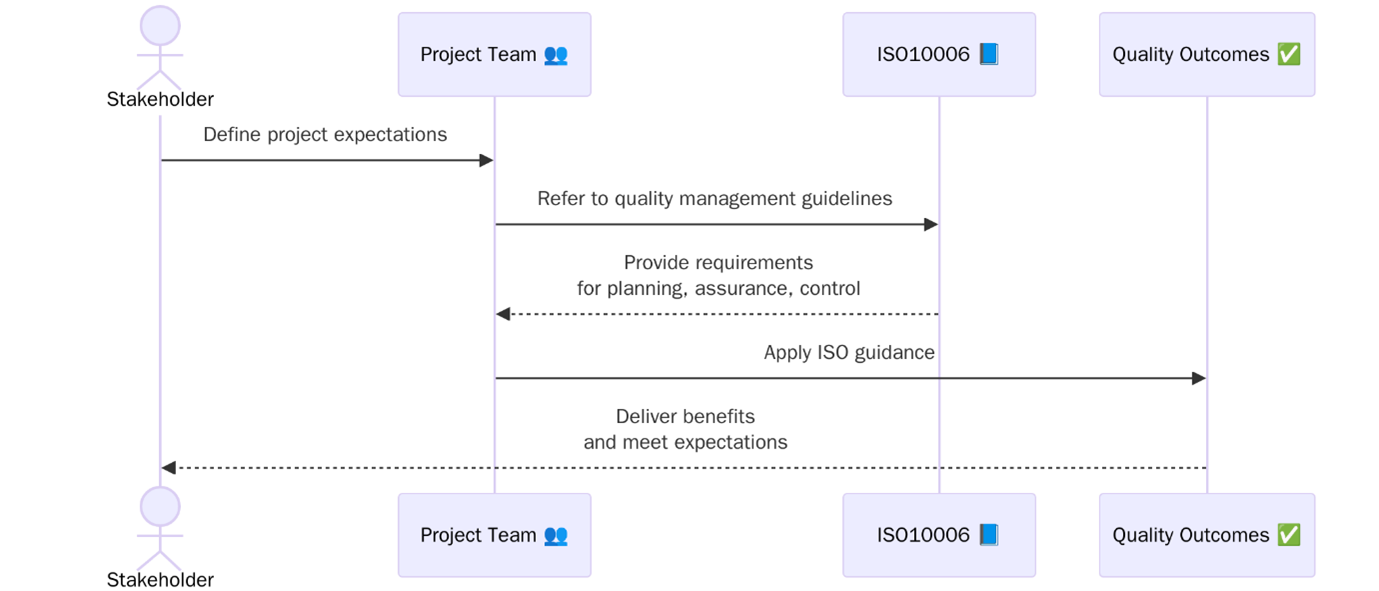
It is especially valuable for industries where quality risks are high, such as infrastructure development, healthcare, and IT system deployments. ISO 10006 helps organizations plan, execute, and close projects with greater accuracy, by ensuring that every deliverable conforms to stakeholder expectations and regulatory requirements. Additionally, it improves collaboration between departments, minimizes rework, and increases customer satisfaction.
By adopting ISO 10006:2017, organizations gain:
- Better project predictability
- Enhanced stakeholder confidence
- Clear quality planning integrated with deliverables
- A structured approach to risk, change, and resource management
- Reduced failure rates due to preventable quality lapses
Improve your project quality outcomes with ISO 10006. Contact our team at support@pacificcert.com!
ISO 10006:2017 Clauses
Clause | Title | Purpose |
4 | Quality Management Principles | Defines quality principles in the project context |
5 | Project Characteristics | Outlines unique project features that impact quality |
6 | Project Quality Management System | Establishes alignment with ISO 9001 QMS requirements |
7 | Management Responsibility | Ensures leadership commitment to project quality |
8 | Resource Management | Assigns resources, responsibilities, and competencies |
9 | Product Realization in Projects | Controls deliverables, processes, and technical validation |
10 | Measurement, Analysis, and Improvement | Covers metrics, reviews, audits, and corrective actions |
Each clause provides a foundational element that, when implemented together, results in a cohesive and consistent approach to quality in project delivery. For example, clause 6 connects the project quality plan directly to organizational policies, while clause 10 ensures performance is regularly measured and improved.
Want to align your project governance with ISO 10006 principles? Email us at support@pacificcert.com.
How to Implement ISO 10006:2017 in Your Organization?
To implement ISO 10006, start by aligning your current project management methodology (PMBOK, PRINCE2, Agile) with the standard’s quality focus. Begin with a thorough gap analysis to identify where your existing processes fall short of ISO 10006 guidelines. Use this as the foundation for building a project-specific quality management system.
Develop quality plans for each project that cover objectives, stakeholder needs, deliverable specifications, and control mechanisms. Integrate quality review points into project phases such as design, development, implementation, and closure. Additionally, assign quality responsibilities within your project team and ensure everyone is trained in relevant tools and standards.
Monitoring and continuous improvement are central to the ISO 10006 philosophy. Collect feedback throughout the project and use it to identify trends or recurring issues. Lessons learned should be documented and used to improve future projects and planning strategies.
Need a customized implementation roadmap for ISO 10006? Get in touch at support@pacificcert.com.
ISO 10006:2017 Implementation Timeline
Week | Activities |
Week 1 | Identify key projects and stakeholders, initiate awareness sessions |
Week 2 | Perform gap analysis, assess current quality management and project practices |
Week 3 | Develop project-specific quality plans and assign quality roles |
Week 4 | Train project teams on ISO 10006-aligned procedures |
Week 5 | Implement quality controls in ongoing projects |
Week 6 | Conduct internal quality review and finalize reporting structure |
Looking for a detailed ISO 10006 rollout plan for your team? Reach us at support@pacificcert.com!
ISO 10006:2017 Requirements
- Define project-specific quality objectives: Ensure that quality goals are aligned with stakeholder expectations and project scope. These objectives form the benchmark against which deliverables are evaluated.
- Establish quality roles within the project team: Assign qualified individuals to oversee quality planning, assurance, and control. Clear responsibilities prevent miscommunication and help maintain accountability.
- Develop a quality plan: Include details on quality methods, standards to be applied, and monitoring activities. The plan should define what success looks like and how it will be measured.
- Integrate risk and change management: Plan for changes and uncertainties that may affect quality, and define mitigation strategies. This ensures flexibility without compromising on standards.
- Implement control methods for deliverables: Apply validation, verification, and review techniques at key stages. This could include checklists, inspections, or stakeholder sign-offs.
- Monitor quality performance: Use KPIs to assess whether project activities meet quality benchmarks. These metrics help maintain transparency and guide mid-course corrections.
- Document lessons learned: Capture improvement opportunities and best practices for future project use. This institutional knowledge is vital for organizational growth.
- Review quality processes regularly: Conduct periodic audits and management reviews to ensure ongoing alignment. These reviews help identify systemic issues and reinforce commitment from leadership.

Need help drafting project quality plans or quality assurance protocols? Contact us at support@pacificcert.com.
Benefits of ISO 10006:2017
Organizations that integrate ISO 10006 benefit from:
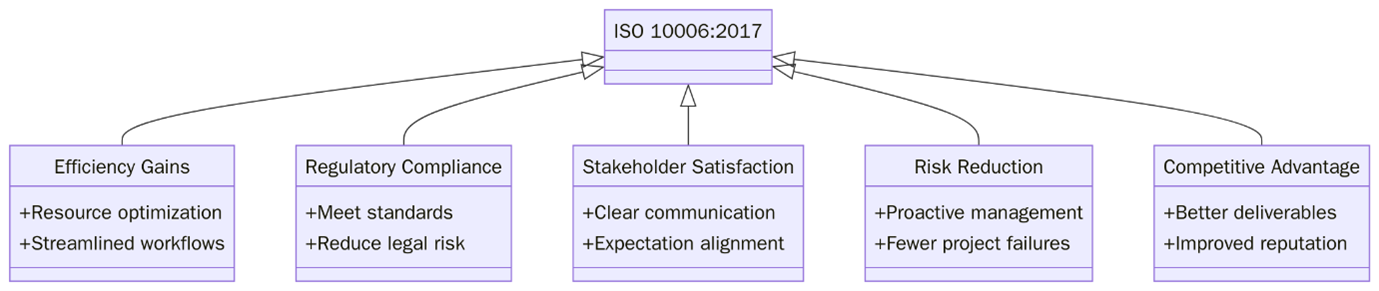
- Greater consistency in project execution and outcomes
- Reduced rework and cost overruns
- Higher stakeholder satisfaction and confidence
- Improved cross-functional collaboration
- Easier integration with ISO 9001 and other QMS standards
- Enhanced risk visibility and proactive management
- Better documentation and control of deliverables
- Stronger audit readiness for client or regulatory inspections
- Structured approach to handling complexity in multi-stakeholder projects
With the increasing complexity and volume of projects globally, the demand for structured quality management in projects is rising. Reports from PMI show that poor quality management practices contribute to over 11% of total project costs. Simultaneously, ISO-aligned organizations report better performance consistency and stakeholder confidence.
The global project management software market, valued at over $10 billion in 2025, is embedding more quality features in tools like Microsoft Project, Primavera, and Jira. ISO 10006 serves as the foundational blueprint that organizations use to define quality within these digital platforms.
In public sector procurement, especially across the EU and Asia-Pacific, organizations increasingly require ISO-aligned project documentation as part of the bid evaluation process. ISO 10006 helps meet these expectations by providing verifiable structure and clarity.
Conclusion
Industries including civil engineering, software development, energy, and defense are standardizing project quality governance through ISO 10006 to achieve regulatory compliance and client satisfaction. As sustainability, traceability, and ESG (Environmental, Social, Governance) metrics rise in importance, ISO 10006 is being extended to cover lifecycle quality and stakeholder reporting.
Want to align your projects with global best practices? Email us at support@pacificcert.com!
FAQs: ISO 10006:2017
What is ISO 10006:2017?
It’s an international guideline for applying quality management principles to projects. It helps organizations ensure that both project processes and outcomes meet stakeholder expectations and quality goals.
Is ISO 10006 a project management standard?
Not exactly. It’s focused specifically on project quality, not project management itself. For broader project management guidance, ISO 21500 is used
Can any organization use ISO 10006?
Yes. It applies to any organization handling projects of any size or complexity—across industries and regardless of project duration
Is ISO 10006 certifiable?
No. ISO 10006 provides guidance rather than requirements; it is not intended for certification or registration purposes
How does ISO 10006 align with ISO 9001 and ISO 21500?
ISO 10006 aligns with ISO 9001:2015 quality-system requirements and complements ISO 21500’s project management guidance.
What is the structure of ISO 10006?
The standard covers two main themes:
1. Quality management in projects: including management responsibility, resource management, product realization, performance measurement.
2. Quality management systems in projects: covering project characteristics, quality principles, project processes, and quality planning.
What quality management principles does ISO 10006 emphasize?
It builds on the seven ISO quality principles: customer focus, leadership, people engagement, process approach, improvement, fact-based decisions, and relationship management.
How should organizations implement ISO 10006?
Begin by mapping your current project approach (e.g., PMBOK, PRINCE2, Agile) against ISO 10006 guidance. Perform a gap analysis, build project-specific quality plans, assign clear roles, embed quality checkpoints in each phase, and capture lessons learned for continuous improvement.
How does ISO 10006 aid risk and communication management?
The standard integrates risk-based thinking into quality planning, ensuring early detection of issues. It also defines roles, responsibilities and processes, which boosts communication and team alignment in projects.
What benefits does ISO 10006 deliver?
Organizations that apply ISO 10006 guidance see improved project predictability, stronger stakeholder confidence, clearer planning and deliverables control, fewer quality failures, and overall enhanced customer satisfaction.
Contact Us
If you need support with ISO 10006:2017, contact us at support@pacificcert.com.
Read More at: Blogs by Pacific Certifications