What is ISO/IEC 11801?

ISO/IEC 11801 sets the international baseline for structured cabling systems used in customer premises. It defines cabling configurations and interface standards for a range of applications including from voice to residential environments. The standard ensures that different communication systems can function over a unified infrastructure.
It supports a wide array of technologies such as Ethernet, VoIP, and multimedia services while allowing for upgrades without rewiring. ISO/IEC 11801-1 is often used by IT designers to network engineers to build systems that remain functional across multiple vendor products and application types.

For audit and certification assistance, contact us at support@pacificcert.com
What is the purpose of ISO/IEC 11801?
The purpose of ISO/IEC 11801 is to provide a structured cabling framework that supports a broad set of information and communication technologies. It offers guidelines on design, installation, and performance expectations. By creating a universal cabling structure, the standard makes it easier for enterprises to maintain and update infrastructure with minimal disruption or cost.
What is scope and applicability of ISO/IEC 11801?
This standard applies to all types of customer premises including commercial buildings, homes, data centers, and industrial facilities. It supports cabling infrastructures of various topologies and lengths, from small setups to expansive multi-floor networks.
ISO/IEC 11801 is used by architects, ICT consultants, system integrators, and installation teams across sectors such as finance, telecom, manufacturing, and education. It is suitable for greenfield projects and for upgrading older cabling systems to meet current transmission demands.
Key Definitions
Generic Cabling: A system of cabling that supports multiple services without being specific to a particular vendor or technology.
Customer Premises: Any location where communication services are delivered to the end user.
Balanced Cabling: Twisted-pair cables used for signal transmission, common in Ethernet networks.
Optical Fibre Cabling: High-speed transmission medium using light to carry data over long distances with low interference.
Channel: The end-to-end transmission path including all cables, patch cords, connectors, and equipment interfaces.
Clause-wise Structure of ISO/IEC 11801
Clause | Title | Description |
1 | Scope | Outlines the extent of application across premises and technologies |
2 | Normative References | Lists supporting standards relevant to performance and materials |
3 | Terms, Definitions, Abbreviations | Provides consistent vocabulary and shorthand used in the document |
4 | Conformance Requirements | States technical obligations for meeting standard compliance |
5 | Cabling Structure | Defines hierarchical network layout and subsystem organization |
6 | Channel and Link Classes | Specifies transmission characteristics across different media types |
7 | Environmental and Installation Considerations | Addresses conditions impacting cable performance |
8 | Design Guidelines | Offers recommendations for layout, pathways, and testing |
9 | Administration | Covers labeling, records, and maintenance data |
What are the requirements of ISO/IEC 11801?
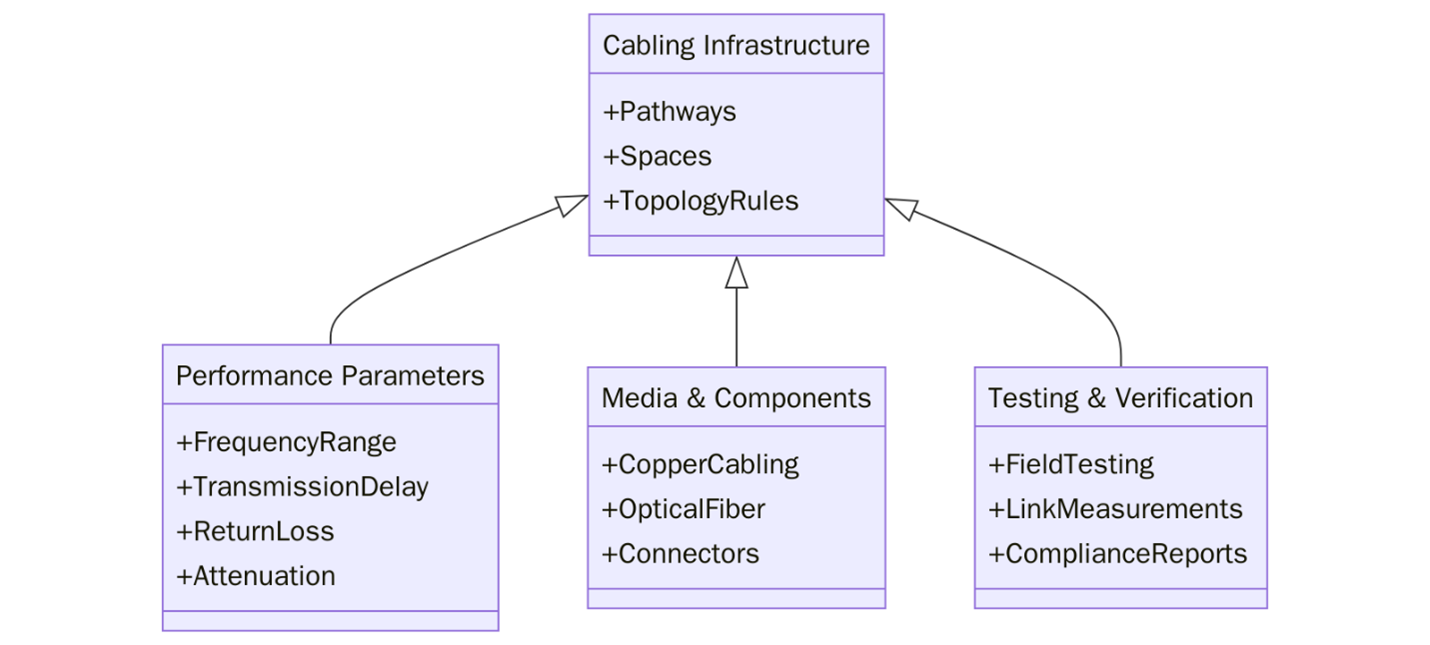
To implement ISO/IEC 11801-1, organizations must design and document their cabling infrastructure to align with its layout and performance guidelines.
The following are key requirements under the standard:
- Define cabling topology using the building’s physical layout and intended applications
- Use only compliant components that meet transmission class criteria (A through FA for copper, OM1–OM5 for fiber)
- Separate backbone and horizontal cabling systems and manage via distributor points
- Ensure cabling lengths do not exceed limits (90 meters for permanent link in copper)
- Maintain pathway clearances and bend radii per manufacturer specifications
- Follow structured labeling and documentation for easier troubleshooting and updates
- Perform testing for parameters such as attenuation, return loss, and NEXT (near-end crosstalk)
- Account for electromagnetic interference, temperature, and humidity during planning
- Align with Class E or higher for applications requiring higher transmission speeds
- Establish grounding and bonding practices where required for system protection
These requirements help organizations build cabling systems that perform predictably and support modern communication technologies.
What are the benefits of ISO/IEC 11801?
Applying ISO/IEC 11801-1 brings measurable value across IT and facility management functions.
Below are the advantages of ISO/IEC 11801:

- Future-ready networks with structured cabling support evolving bandwidth needs
- Consistency across vendors and hardware platforms using a unified cabling standard
- Reduced installation errors through clearly defined layout and design protocols
- Lower maintenance effort with documented labeling and access pathways
- Improved uptime with tested channel performance and defined link limits
- Easier upgrades and technology shifts without replacing entire cabling systems
- Better use of space and routing via planned pathways and distributor zones
The rise of intelligent buildings using structured cabling to support automation voice data and security systems on a single network. Enterprises are moving toward modular cabling designs that simplify future upgrades without large-scale rewiring.
Eligibility Criteria
Any organization installing or managing structured cabling in a commercial, residential, or industrial setting can apply ISO/IEC 11801-1. There are no restrictions based on business size or industry type.
It is particularly suited for companies expanding IT infrastructure, building new facilities, or replacing outdated networks. Installers and consultants should be familiar with related standards such as ISO/IEC 14763-2 for testing and ISO/IEC 30129 for telecommunications cabling.
What is the certification process of ISO/IEC 11801?
- Review building layout and IT service needs
- Develop structured cabling design as per standard layout
- Select compliant cables, connectors, and hardware
- Stage 1 audit – documentation review and planning inspection
- Stage 2 audit – on-site evaluation of cabling, routing, and test reports
- Certification decision
- Ongoing updates and audits for changes or expansions in network layout
Certification confirms your organization meets technical requirements for generic cabling systems under ISO/IEC 11801-1.
What is ISO/IEC 11801-1 certification timeline?
A typical certification project takes between six to ten weeks, depending on the scale and complexity of the cabling system. Projects with pre-existing network design and test documentation can expect faster results. For multi-site installations, scheduling and sampling methods may affect the overall duration.
What is the cost of ISO/IEC 11801?
Costs depend on the size of the site, number of network nodes, and types of cabling used (fiber, copper, or hybrid). Additional factors include whether the audit is part of a bundled assessment with other IT or infrastructure standards. Organizations with complete records and previous testing data can reduce evaluation effort and cost.
How can Pacific Certifications help?
Pacific Certifications provides third-party audits for ISO/IEC 11801-1. Our team evaluates network layout plans, installation practices, component choices, and final performance test data.
We also conduct integrated audits with related standards like ISO/IEC 14763-2 or ISO 9001 for companies looking to cover installation quality and documentation together. Our audit process focuses on actual infrastructure setup and use, not just drawings or theory.
Training and Courses
Lead Auditor Training: Designed for professionals who evaluate structured cabling projects and infrastructure performance.
Lead Implementer Training: Teaches how to design and install ISO/IEC 11801-1-compliant systems across various environments.
Internal Auditor Training: Helps IT and facility teams verify conformity through periodic internal reviews.
Pacific Certifications provides accredited training programs. If your organization is looking for ISO/IEC 11801-1 training our team is equipped to help you. Contact us at support@pacificcert.com
FAQs
Is ISO/IEC 11801-1 limited to office buildings?
No, it applies to homes, factories, schools, and data centers as well.
Can it be used with fiber optic cabling?
Yes, the standard includes both balanced copper and optical fiber types.
Is certification required to install structured cabling?
Not mandatory, but certification provides formal recognition and audit records.
Can older systems be upgraded to comply with ISO/IEC 11801-1?
Yes, upgrades are possible by aligning design and testing with the standard’s criteria.
How often should a recertification be done?
Typically every 2–3 years or after major infrastructure changes.
What cabling classes and categories does ISO/IEC 11801-1 define?
It maps copper “classes” to familiar cable categories—for example Class D (Cat5e, 100 MHz), Class E (Cat6, 250 MHz), Class EA (Cat6A, 500 MHz), Class F/FA (Cat7/7A), and the 2 GHz Classes I and II (Cat8.1/Cat8.2). It also includes fiber designations (OM3/OM4/OM5 for multimode; OS1/OS2 for single-mode).
What are the maximum lengths for links under ISO/IEC 11801-1?
The standard caps the total channel length at 100 m and the fixed permanent link at 90 m (with the remaining length made up by patch/cords). Length allowances are adjusted if you exceed 10 m of patching.
How is ISO/IEC 11801 different from TIA-568?
They’re closely aligned, but ISO/IEC 11801 is the international/JTC 1 route while TIA-568 is the U.S. standard; terminology and some details differ, and ISO historically reflects broader (incl. European) practices. Many manufacturers design to satisfy both.
Does ISO/IEC 11801-1 include Cat8?
Yes. The 2017 edition introduced Class I (Category 8.1) and Class II (Category 8.2) up to 2 GHz for short, high-speed copper links (e.g., data center use).
What cabling topology does ISO/IEC 11801-1 specify?
A hierarchical star: campus backbone (Campus Distributor to Building Distributors), building backbone (Building Distributor to Floor Distributors) and horizontal cabling (Floor Distributor to outlets). The standard also allows an optional consolidation point in the horizontal link.
Ready to get ISO/IEC 11801 certified?
Contact Pacific Certifications to begin your certification journey today!
Suggested Certifications –
Read more: Pacific Blogs