Your complete guide to accredited food safety certification, recognised by clients, regulators, and supply chains worldwide.
Food safety is not negotiable. ISO 22000 certification demonstrates that your Food Safety Management System has been independently audited and verified against the world’s leading food safety standard, giving your customers, partners, and regulators the confidence that every product leaving your organisation meets the highest standards of food safety management.
ISO 22000 is the internationally recognised standard for Food Safety Management Systems (FSMS), developed by the International Organization for Standardization. It provides organisations across the entire food chain with a structured framework to identify, manage, and control food safety hazards, ensuring that food is safe for consumption at every stage from production and processing through to storage, distribution, and delivery.
The current version, ISO 22000:2018, combines the principles of Hazard Analysis and Critical Control Points (HACCP) with the structure of a broader management system, making it one of the most comprehensive food safety frameworks available. Built on the Annex SL structure, it aligns seamlessly with ISO 9001 and ISO 14001, allowing organisations to integrate food safety management with quality and environmental systems under a single, efficient framework.
ISO 22000 applies to every organisation in the food chain, regardless of size or sector. Whether you are a primary producer, food manufacturer, packaging supplier, logistics provider, retailer, or catering company, the standard is designed to scale to your operational context and food safety risks.
ISO 22000 is globally recognised by food industry regulators, retailers, and procurement teams as credible evidence that food safety is managed systematically and not left to chance.
Get in touch with Pacific Certifications today for a seamless, transparent path to accredited registration. Our global experts are available 24/7 to support your operational needs.
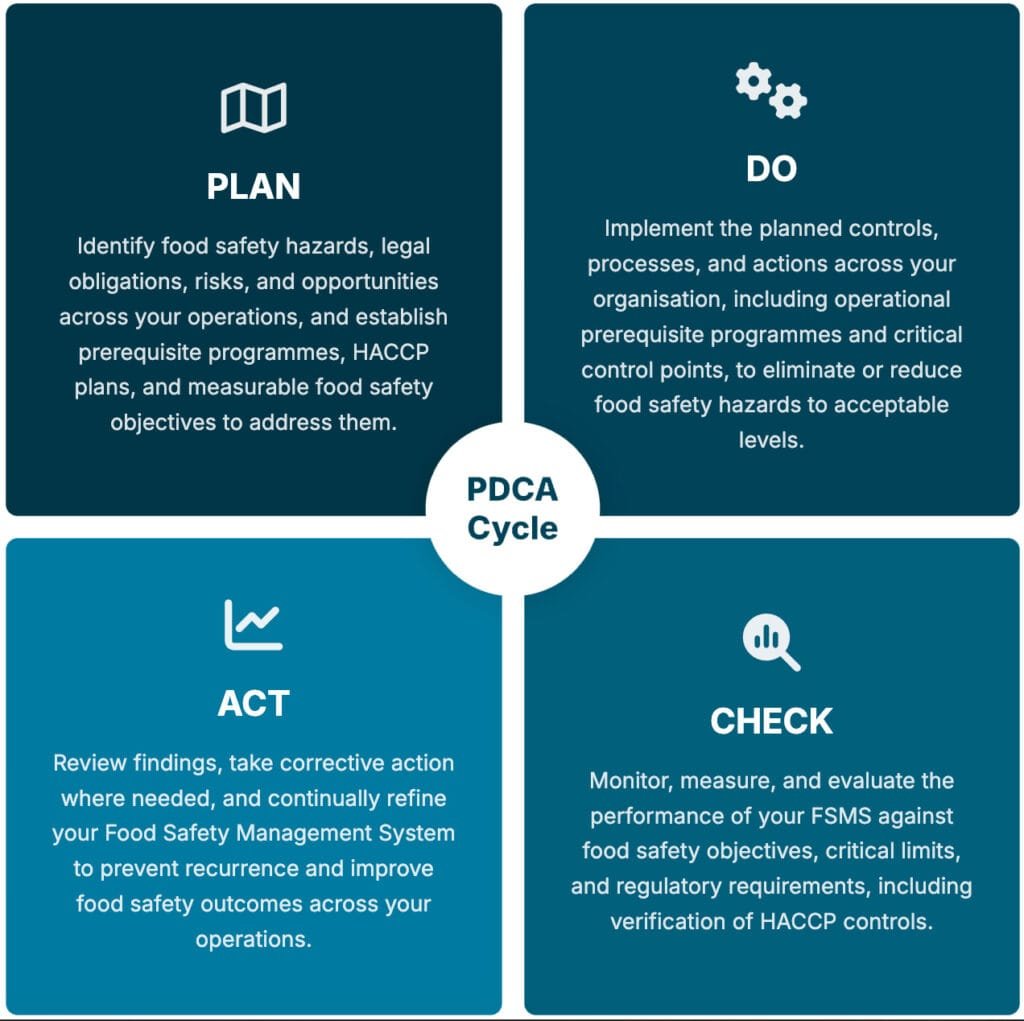
The PDCA (Plan-Do-Check-Act) cycle is the operational foundation of ISO 22000, providing a structured approach to managing food safety hazards and driving continual improvement across the entire food chain. It ensures your Food Safety Management System remains proactive, consistent, and effective from farm to fork.
From first audit to final certificate, our expert auditors support you at every stage with clarity, efficiency, and globally recognised accreditation.
Receive an independently audited, globally recognised ISO 22000 certificate through our clear, structured two-stage audit process.
Equip your teams with the knowledge and skills needed to implement and maintain an effective Food Safety Management System, from awareness through to lead auditor level.
Already certified to ISO 9001, ISO 14001, or other ISO standards? We combine your food safety audit with existing certifications into a single, efficient programme that saves time and reduces disruption.
Before your formal audit, review your current food safety practices internally against ISO 22000 requirements to identify and close any gaps in advance
ISO 22000 has evolved across two versions, reflecting how organisations across the food chain are expected to manage food safety in an increasingly regulated and complex global environment.
| Parameter | ISO 22000:2005 | ISO 22000:2018 |
|---|---|---|
| Structural Template | Standalone standard with its own unique structure and format. | Annex SL harmonized structure enabling seamless integration with ISO 9001, ISO 14001, and other ISO standards. |
| Risk Approach | Hazard analysis focused primarily on operational food safety risks. | Two-level risk approach combining organisational risk-based thinking with operational hazard analysis and HACCP principles. |
| HACCP Integration | HACCP principles incorporated but with limited structural clarity. | Stronger, clearer integration of HACCP principles with operational prerequisite programmes and critical control points. |
| Governance | Management representative designated to oversee food safety. | Direct top management accountability with active leadership commitment embedded as a core requirement. |
| Documentation | Prescriptive documentation requirements with mandatory procedures. | Flexible, outcome-focused documentation based on organisational context and operational food safety needs. |
| Focus Area | Hazard control and regulatory compliance across the food chain. | Continual improvement, risk-based thinking, supply chain food safety, and integration with broader management systems. |
ISO 22000 is built on a combination of core food safety principles and broader management system principles, working together to ensure food safety is managed systematically across the entire food chain.
The foundation of ISO 22000. Organisations must systematically identify, evaluate, and control food safety hazards through a structured HACCP plan, ensuring risks are addressed at the points where they matter most.
Basic conditions and activities necessary to maintain a hygienic environment throughout the food chain, including hygiene practices, pest control, allergen management, and facility maintenance.
Organisations must identify and address both operational food safety risks and broader organisational risks that could affect the effectiveness of the Food Safety Management System.
Top management must actively drive food safety strategy, establish a food safety policy, and ensure the FSMS is resourced, implemented, and continuously improved.
Effective internal and external communication is essential. Food safety information must flow clearly between suppliers, producers, processors, distributors, and customers to prevent hazards from being overlooked at any stage.
Organisations must consistently monitor performance, learn from incidents and non-conformities, and raise the bar on food safety outcomes over time.
Organisations must be able to identify and trace materials, products, and processes throughout the food chain to enable rapid and effective response in the event of a food safety incident.
ISO 22000 follows a 10-clause framework, with Clauses 4 through 10 defining the formal requirements assessed during certification.
| Clause | Title | Scope & Requirement Objective |
|---|---|---|
| Clause 4 | Context of the Organisation | Identify internal and external factors affecting food safety, understand stakeholder needs, and define the scope of your FSMS. |
| Clause 5 | Leadership | Top management must demonstrate active commitment, establish a food safety policy, and assign clear roles and responsibilities including a designated food safety team leader. |
| Clause 6 | Planning | Identify food safety risks and opportunities, address legal and regulatory obligations, and set measurable food safety objectives and plans to achieve them. |
| Clause 7 | Support | Ensure adequate resources, competence, awareness, communication, and control of documented information across the organisation and food chain. |
| Clause 8 | Operation | Plan and control all processes including prerequisite programmes, hazard analysis, HACCP plans, and operational controls to manage food safety hazards effectively. |
| Clause 9 | Performance Evaluation | Monitor and measure FSMS performance, verify HACCP controls, conduct internal audits, and carry out management reviews against set food safety objectives. |
| Clause 10 | Improvement | Address non-conformities, manage unsafe products, implement corrective actions, and drive continual improvement of food safety performance and the FSMS. |
Everything you need to prepare for ISO 22000 certification, in one place.
The path to certification balances system building with rigorous auditing.
Submit your application and tell us about your organisation, food safety scope, and position in the food chain.
A documentation review to confirm your FSMS, HACCP plans, and prerequisite programmes are adequately developed and ready for the on-site assessment.
Our auditor evaluates whether your FSMS is fully implemented, operational, and effective across your food safety operations, including a review of your HACCP controls and critical control points.
Upon successful completion, your ISO 22000 certificate is issued, valid for three years.
Annual surveillance audits maintain your certification, followed by full recertification at the end of the three-year cycle.
ISO 22000 certification costs vary depending on your organisation’s size, number of locations, industry, and the complexity of your food safety operations and supply chain. If you are integrating ISO 22000 with other ISO standards such as ISO 9001 or ISO 14001 under a single audit programme, this can also influence the overall cost.
At Pacific Certifications, we offer transparent, competitive pricing with no hidden charges. Contact us for a tailored quote or use our free cost calculator to get an instant estimate.
Food safety expectations have never been more stringent. In 2026, retailers, regulators, and supply chain partners expect organisations across the food chain to demonstrate verified, independently audited food safety credentials. A single food safety incident can result in product recalls, regulatory action, and reputational damage that takes years to recover from. ISO 22000 certification shows that your organisation manages food safety as a system, not as an assumption.
With global food supply chains becoming more complex and consumer expectations around food safety transparency continuing to rise, certified organisations are better positioned to access new markets, retain existing clients, and operate with the confidence that comes from having food safety independently verified.
We provide deep, sector-specific auditing aligned directly with your daily operations.
Build the internal expertise your organisation needs to implement, maintain, and audit ISO 22000 effectively.
For professionals looking to conduct and lead ISO 22000 audits with confidence and internationally recognised credentials.
For those responsible for designing, implementing, and maintaining a Food Safety Management System within their organisation.
For teams and individuals who need a clear, practical understanding of ISO 22000 and what it means for food safety in their day-to-day work.
We are not just a certification body, we are the partner that helps your organisation earn trust, improve performance, and grow with confidence.
Accredited by the ABIS (Accreditation Board for International Standards), our certificates are accepted by clients, regulators, and procurement bodies worldwide.
Our auditors bring sector-specific knowledge to every engagement, ensuring your audit is relevant, thorough, and conducted by someone who understands your business.
We operate globally with the capability to conduct both remote and on-site audits, delivering consistent, high-quality certification services wherever you are.
From your first enquiry to your final certificate, we keep things clear, efficient, and tailored to your organisation — no unnecessary delays, no hidden costs.
ISO 22000 certification is independent, third-party confirmation that your organisation has a structured Food Safety Management System that meets the requirements of the internationally recognised ISO 22000 standard. It demonstrates to customers, retailers, and regulators that food safety in your organisation is proactively managed, independently verified, and continuously improved.
ISO 22000:2018 is the current version of the standard and introduced significant updates including adoption of the Annex SL harmonized structure for easier integration with other ISO standards, a stronger two-level risk approach combining organisational risk-based thinking with HACCP principles, and clearer requirements around leadership accountability and continual improvement. Organisations still certified under ISO 22000:2005 should have already transitioned to the 2018 version.
Most organisations complete the certification process within 3 to 6 months. The timeline depends on the size of your organisation, the complexity of your food safety operations, and how developed your existing food safety practices and HACCP plans are. Our team will provide a realistic timeline from your very first conversation with us.
Certification costs are based on your organisation's size, number of sites, position in the food chain, and the complexity of your food safety operations. At Pacific Certifications, we provide transparent, competitive pricing with no hidden charges. Use our free cost calculator or contact us directly for a tailored estimate.
ISO 22000 certification is voluntary in most markets. However, it is increasingly required by major retailers, food industry procurement teams, and export markets as a condition of doing business. In many food sectors, certification has moved from being a differentiator to a baseline expectation.
ISO 22000 certificates are valid for three years. Annual surveillance audits are conducted during this period to confirm your FSMS remains effective and compliant. A full recertification audit is carried out at the end of the three-year cycle to renew your certificate.
Yes. Pacific Certifications offers remote audits using structured, accreditation-compliant methodologies. However, for organisations with physical food production, processing, or storage facilities, on-site audits are often more appropriate to properly evaluate the implementation of food safety controls and HACCP plans in practice.
HACCP is a food safety methodology focused specifically on identifying and controlling hazards at critical control points in the production process. ISO 22000 incorporates HACCP principles within a broader management system framework, adding requirements around leadership, planning, support, performance evaluation, and continual improvement. ISO 22000 provides a more comprehensive and structured approach to food safety management than HACCP alone.
Yes. ISO 22000:2018 shares the Annex SL common framework with ISO 9001, ISO 14001, and ISO 45001, making integration straightforward. Many food industry organisations audit multiple standards together in a single integrated programme, reducing duplication, saving time, and creating a more cohesive management system.
A failed audit does not end the process. If non-conformities are identified, you will be given a defined timeframe to address them and provide evidence of corrective action. Our auditors approach every engagement constructively, with the goal of helping your organisation achieve and maintain certification, not to create unnecessary barriers.
Get in touch with us today. Complete the form and we’ll be happy to assist you.
This will close in 20 seconds
WhatsApp us