Introduction
Luxembourg is a high-trust business hub, known for financial services, cross-border operations and a strong services economy, supported by logistics, ICT and specialized professional services. In this environment, buyers, regulators and procurement teams do not rely on promises alone. They expect documented proof that teams control quality, manage risks, protect data and maintain records when issues arise, especially when delivery involves multiple sites, teams and subcontractors.
ISO certification helps organizations in Luxembourg show that they plan, deliver, check and improve work through a structured management system. It supports consistent outcomes in purchasing, supplier evaluation, service delivery, inspection routines, incident reporting and corrective action closure and it also supports vendor approvals, tender readiness and faster onboarding for contracts that use standardized supplier checks.
For more information on ISO certification services, contact us at support@pacificcert.com, or visit www.pacificcert.com.
Quick Summary
ISO certifications help organizations in Luxembourg align daily operations with recognized management system standards. The most requested standards include ISO 9001 (quality management), ISO 14001 (environmental management), ISO 45001 (occupational health and safety), ISO/IEC 27001 (information security), ISO 22000 (food safety), ISO 50001 (energy management) and ISO 13485 (medical devices quality management), where applicable. These certifications support buyer approvals, tender readiness, consistent delivery and controlled records across teams and sites.
Economic context and industry overview
Luxembourg’s economy runs on services and ranks as one of Europe’s most internationalized markets, with strong cross-border activity and strict expectations around documentation, governance and supplier discipline. The country reports GDP of about US$ 93.2 billion, which supports a dense network of regulated services, outsourcing providers, IT vendors, facilities operators and specialized suppliers.
The scale of Luxembourg’s fund and financial services ecosystem plays a key role. Luxembourg-domiciled investment funds hold net assets of about EUR 6.2 trillion, which means many service providers, technology partners and operational suppliers work in environments where client audits, vendor onboarding checks and evidence-based controls remain standard practice.
Sector structure also explains why organizations widely recognize ISO management systems in supplier approvals. Services contribute about 81.87% of GDP, which drives demand for ISO 9001 in service delivery, ISO/IEC 27001 in data-heavy operations and ISO 45001 in facilities, construction and site work.
Why ISO certifications matter in Luxembourg?
ISO certifications matter because they convert routine work into auditable evidence. When a buyer outsources IT support, managed services, facilities services, construction, maintenance, cleaning, logistics coordination, or regulated service support, they want proof that delivery does not depend on individual experience. ISO standards help define how work is done, how changes are controlled, how incidents and complaints are handled and how corrective actions are closed with records.
ISO certification is also practical for multi-site delivery and multi-team operations. It helps standardize onboarding, training records, contractor supervision routines and reporting methods, so the same expectations apply across every site and across every shift.
Important standards often requested by buyers in Luxembourg
| ISO Standard | Industry or sector | Why buyers request it |
| ISO 9001 | Services, logistics, outsourcing, facilities | Consistent delivery, supplier control, service reporting, complaint handling |
| ISO 14001 | Facilities, construction, site operations | Waste control, spill readiness, chemical storage, site impact management |
| ISO 45001 | Construction, maintenance, warehouses | Hazard control, incident reporting, contractor control, safer work methods |
| ISO/IEC 27001 | IT services, fintech support, shared services | Access control, backups, incident response, supplier security checks |
| ISO 22000 | Catering, food supply, hospitality | Hygiene control, allergen handling, traceability, monitoring records |
| ISO 50001 | Large facilities, energy-heavy operations | Energy baselines, monitoring, action tracking, performance review |
| ISO 13485 | Healthcare supply, packaging, servicing support | Traceability, validation, controlled documentation for buyer approvals |
Popular ISO standards in Luxembourg
ISO 9001 in Luxembourg (Quality management)
ISO 9001 helps Luxembourg-based businesses build consistent outcomes through defined processes, measurable controls and clear responsibilities. It supports workflows for purchasing, supplier evaluation, service delivery, inspection routines and complaint handling. For service providers, it supports standardized onboarding, job execution, service reporting and closure records. For product-based or technical operations, it supports acceptance criteria, traceability and corrective actions when defects occur. ISO 9001 is useful when buyers want proof that quality is controlled across teams and not dependent on individual experience.
Read more: ISO 9001
ISO 14001 in Luxembourg (Environmental management)
ISO 14001 helps organizations control environmental aspects tied to operations, facilities and suppliers. In practice, this includes waste segregation, chemical storage control, spill-response routines and monitoring of environmental performance. For facility operations, it supports control of waste streams, storage areas, disposal vendor checks and incident reporting, with evidence retained for audits.
Read more: ISO 14001
ISO 45001 in Luxembourg (Occupational health and safety)
ISO 45001 supports safer work conditions by turning hazard control into a planned system, with training and records. It helps identify risks such as vehicle movement, lifting operations, working at height, machinery hazards, electrical hazards and contractor risks, then puts controls in place through procedures, competence checks and supervision routines. It also supports incident reporting, corrective actions and emergency readiness, which many clients review during vendor onboarding.
Read more: ISO 45001
ISO/IEC 27001 in Luxembourg (Information security)
ISO/IEC 27001 is used to protect information across confidentiality, integrity and availability. For organizations using customer databases, HR platforms, cloud services, outsourced IT, or vendor access workflows, ISO/IEC 27001 supports access control, onboarding and offboarding discipline, incident response steps, supplier security checks and backup routines. It is especially relevant for organizations supporting financial services and any vendor handling sensitive client data.
Read more: ISO 27001
ISO 22000 in Luxembourg (Food safety management)
ISO 22000 supports food safety management using HACCP-based thinking and documented controls. It helps food businesses manage hazards from receiving and storage, through preparation, packing and service. Controls commonly include hygiene routines, allergen awareness, temperature monitoring, supplier approval, traceability records and corrective actions for deviations.
Read more: ISO 22000
ISO 13485 in Luxembourg (Medical devices quality management)
ISO 13485 is used by organizations involved in medical device related manufacturing, packaging, servicing, or supply. It supports controlled documentation, traceability, validation steps and quality controls tied to patient safety expectations. It is relevant where suppliers support regulated healthcare supply chains and where buyers require evidence-based process control.
Read more: ISO 13485
ISO 50001 in Luxembourg (Energy management)
ISO 50001 helps organizations manage energy use through monitoring, planning and improvement actions. It supports building an energy baseline, tracking consumption, identifying major energy uses and improving performance through maintenance routines and operational controls. For large facilities with high electricity demand, ISO 50001 supports measured energy control and record-based performance review.
Read more: ISO 50001
Certification process in Luxembourg
Step 1 – Gap review and initial assessment:
Confirm your scope, sites, products or services and key processes, then identify gaps against the selected ISO standard, including outsourced processes such as subcontracted cleaning, security, facilities support, or IT.
Step 2 – Documentation build:
Prepare policies, procedures, work instructions and controlled forms that match real operations and avoid generic documents that teams will not use.
Step 3 – System roll-out:
Implement controls across departments and locations, assign process owners, define responsibilities and set record routines that teams can maintain during busy periods.
Step 4 – Training and awareness:
Provide role-based training for employees and contractors, confirm competence for task-critical roles and retain training evidence such as attendance, evaluations and authorizations.
Step 5 – Internal audit:
Conduct internal audits across the full scope, record findings clearly, then track corrective actions to closure with evidence.
Step 6 – Management review:
Management reviews audit results, performance trends, incidents, customer feedback, supplier performance and improvement actions, then records decisions, owners and timelines.
Step 7 – Stage-1 audit:
The certification body reviews documented readiness, scope and audit planning, then any gaps are addressed before Stage-2.
Step 8 – Stage-2 audit:
Auditors verify implementation through interviews, site checks and record review across key processes such as purchasing, delivery, inspections, security controls and corrective actions.
Step 9 – Certificate issuance:
After closure of nonconformities and acceptance of corrective action evidence, the certificate is issued for the defined scope.
Step 10 – Surveillance and recertification:
Surveillance audits verify continued conformity and recertification renews the certificate at the end of the cycle.
What are the requirements of ISO certifications in Luxembourg?
ISO requirements vary by standard. Most organizations prepare around a shared management system structure where controls link directly with real work and records prove consistency. Below are some of the key requirements:
- Leadership commitment shown through policy, roles, responsibilities and management review
- Defined scope covering sites, services, exclusions and outsourced processes
- Process control for core workflows such as purchasing, service delivery, facilities support and IT operations
- Risk review and practical controls tied to operational realities, including contractor and supplier risks
- Document and record control so teams use current versions and retain required evidence
- Competence management including onboarding, training and role-based authorizations
- Supplier and contractor controls through evaluation, approval, monitoring and corrective actions
- Monitoring and measurement through checks, inspections, targets and trend review
- Internal audits completed across the scope, with findings tracked to closure
- Corrective actions with root-cause review, plus follow-up checks to prevent repeat issues
Benefits of ISO Certifications in Luxembourg
ISO certifications support buyer confidence because they provide auditable evidence that processes are controlled and reviewed. Below are some of the key benefits:
- Faster vendor approval, because buyers recognize ISO-based controls and records
- More consistent delivery across teams, sites and subcontractors
- Fewer repeat issues, through corrective action tracking and closure evidence
- Stronger supplier control, through evaluation routines and traceable purchasing records
- Safer work practices, through hazard controls, competence checks and incident learning
- Better environmental control, through waste control, spill readiness and chemical handling evidence
- Improved data protection, through access controls, backups and incident response routines
- Clearer onboarding, through role-based training and usable work instructions
- Better food safety assurance, through hygiene monitoring, allergen control and traceability
- Stronger tender readiness, with records that align with buyer checklists
To get ISO certified for your operations, reach out to our team at support@pacificcert.com.
Market trends and industry outlook
Luxembourg’s market trends reflect its services-led structure and the scale of financial services activity. Services account for about 81.87% of GDP, which explains why buyers often treat ISO 9001 and ISO/IEC 27001 as practical entry requirements for supplier approvals, especially in outsourced services, technology support and regulated environments.
Investment fund scale also drives this trend. Luxembourg investment funds hold about EUR 6.2 trillion in net assets, and that level of institutional activity increases vendor scrutiny on data handling, change control, supplier risk and evidence-based controls, since client audits and third-party reviews occur frequently.
On broader outlook indicators, IMF data for Luxembourg shows real GDP growth around 2.1%, which supports ongoing demand for supplier services and for structured vendor screening programs, particularly in finance-linked services, IT and facilities support.
Challenges faced in Luxembourg
Organizations often face practical constraints that make consistent implementation harder across sites, teams and subcontractors. A common issue during busy periods is poor record discipline. Teams may complete work correctly but fail to keep evidence such as service logs, inspection records, access approvals, handover notes, maintenance records or supplier evaluations. Audits often raise findings when records are missing because teams must prove controls through documented evidence.
Contractor and subcontractor control, is another recurring challenge, especially in facilities services, construction, maintenance and outsourced operations. Without a defined contractor routine covering selection, induction, supervision and performance review, gaps can show up as inconsistent checklists, unclear responsibilities, repeat issues and delayed corrective action closure.
Data-heavy service providers also face challenges when they try to maintain consistent access control, offboarding discipline, backup testing and supplier security checks while systems change frequently and multiple vendors stay involved. ISO/IEC 27001 supports control, but teams must assign clear responsibilities, maintain records and run internal audits to confirm that controls work as intended.
Cost of ISO certifications in Luxembourg
ISO certification cost depends on the standard, scope, number of sites, headcount and process complexity. Multi-site audits usually take more time because auditors must check evidence across multiple locations. Higher-risk scopes such as construction, food operations, or complex IT environments can also increase audit time, due to the controls that must be verified.
For a free customized quote for your organization, contact us at support@pacificcert.com.
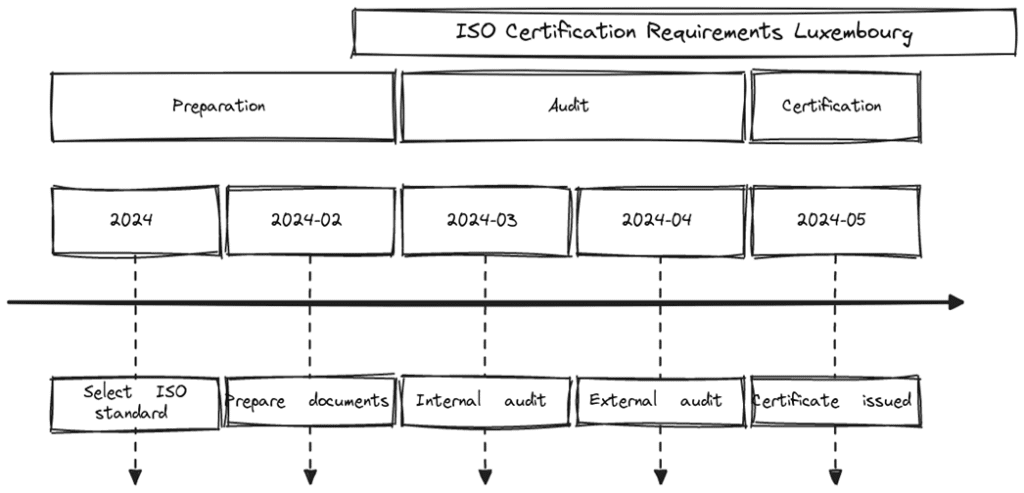
Timeline for ISO certification in Luxembourg
Timelines depend on scope readiness and how quickly teams can apply controls across locations. Smaller organizations with a clear scope and stable routines, often complete certification in a few months. Mid-sized organizations usually take longer because training, internal audits and corrective action closure require coordination across departments. Multi-site scopes can take additional time since consistent implementation must be shown across locations during Stage-2.
How Pacific Certifications can help?
Pacific Certifications is an independent ABIS-accredited certification body providing third-party certification audits against ISO standards. We support organizations across hospitality, logistics, construction, IT services, food supply and manufacturing support work. Our audit approach follows the scope and sites, you operate, while focusing on practical evidence such as records, interviews and on-site verification.
Pacific Certifications provides services including:
- Certification audits for ISO 9001, ISO 14001, ISO 45001, ISO 27001, ISO 22000, ISO 50001 and numerous other standards
- Multi-site certification for organizations operating across multiple locations in Luxembourg, or regionally
- Industry-specific expertise with auditors experienced in your sector’s unique requirements and challenges
- Surveillance audits conducted annually to verify continued compliance and system effectiveness
- Recertification audits every three years providing comprehensive system reviews
- Expert auditors combining technical standard knowledge, with practical business understanding
- International recognition ensuring your certificate is accepted globally, for tenders and contracts
Contact Pacific Certifications at support@pacificcert.com or visit www.pacificcert.com to discuss your certification needs and learn how we can support your quality journey.
Training and Courses
Before selecting a course, most organizations align training with job roles and audit readiness, so training stays practical across sites and shifts.
- Lead auditor training: Covers audit planning, audit program management, interviewing techniques, sampling methods, evidence evaluation, nonconformity writing and audit reporting, aligned with ISO audit practice.
- Lead implementer training: Covers how to build, run and maintain a management system that matches real operations, including scope-setting, process mapping, internal audits, management review and corrective action closure.
Pacific Certifications provides accredited training programs. If your organization is looking for ISO training, our team is equipped to help you. Contact us at support@pacificcert.com.
Frequently Asked Questions
Which ISO standards are most requested by buyers in Luxembourg?
ISO 9001, ISO 45001 and ISO/IEC 27001 are common requests and ISO 14001 is also widely used.
Can small businesses in Luxembourg get ISO certified?
Yes, if the scope is clear and records are maintained consistently.
What is the difference between Stage-1 and Stage-2 audits?
Stage-1 checks readiness and documented controls, while Stage-2 checks implementation using evidence and records.
Do we need an internal audit before the certification audit?
Yes, internal audits are expected before Stage-2.
Can ISO 9001 and ISO/IEC 27001 be audited together?
Yes, if the management system is integrated and the scope is defined clearly.
What records do auditors usually review first?
Scope definition, internal audit results, corrective actions and key operational records.
How often are surveillance audits carried out?
Typically, once each year, during the certification cycle.
What usually increases certification cost the most?
More sites, more staff and higher process complexity, usually increase audit time.
Does ISO certification help with vendor approvals?
Yes, many buyers use ISO certificates and supporting records, as supplier screening tools.
How long does certification usually take?
It depends on readiness, scope and number of sites, but it is often completed within a few months.
Contact Us
If you need support with ISO Certifications in Luxembourg, contact us at support@pacificcert.com.
Read More at: Blogs by Pacific Certifications