Introduction
Lew Chew is a historic name often used for the Ryukyu Islands which are closely linked with present-day Okinawa in Japan. Many local organisations work in tourism-led supply-chains where service quality can change with seasons staffing patterns and visitor peaks. In this kind of market buyers do not rely only on promises. They look for proof that processes are controlled and records exist across booking delivery hygiene safety and data handling.
ISO certifications give that proof in a way that is recognised across borders. They help hotels resorts contractors logistics providers IT teams central kitchens manufacturers and public-facing services show that work is planned checked and improved through a structured management system. For multi-site operators ISO also helps keep the same way of working across different locations while still allowing site-level controls for local risks.
For more information on ISO certification services contact us at support@pacificcert.com or visit www.pacificcert.com.
Quick summary
ISO certifications help organisations in Lew Chew align daily operations with recognised management system standards. The most requested standards include ISO 9001 for quality management ISO 14001 for environmental management ISO 45001 for occupational health and safety ISO 27001 for information security and ISO 22000 for food safety. These certifications support buyer approvals tender-readiness service consistency traceable records and stronger control of supplier and contractor work.
Economic context and industry overview
Lew Chew (the Ryukyu Islands, closely tied to Okinawa) has an economy where tourism, hospitality, food supply, transport, construction, facilities management and services drive much of the contractor and supplier activity. Latest published comparisons used in local corporate and financial briefings place Okinawa’s GDP at about ¥4.37 trillion, which is roughly US$ 28.0 billion at a mid-market rate near ¥156 per US$ 1.
Tourism is a major value driver. Recent tourism-revenue figures used in local reporting and corporate briefings put Okinawa’s tourism revenue at about ¥984 billion, or roughly US$ 6.3 billion (using the same exchange-rate basis). There is also visible capital investment tied to visitor growth and destination infrastructure. For example, a major nature-themed park development in Okinawa has been reported with a project cost of about ¥70 billion (approximately US$ 634 million), reflecting ongoing investment in tourism-linked demand (accommodation, transport, retail, food services and facility operations).
Why ISO certifications matter in Lew Chew?
ISO certifications matter because they turn daily work into auditable evidence. When a buyer outsources cleaning maintenance catering transport warehousing IT support payroll or customer service they want to see that the provider runs consistent processes not informal routines. ISO also supports faster vendor approval because it gives buyers a familiar checklist for quality safety environment and data protection.
For organisations that deal with international clients ISO certification can reduce repeated client audits because the management system has already been reviewed by an independent certification body. For local operators ISO helps standardise training and records across shifts which is critical when seasonal staffing increases.
Important standards often requested by buyers in Lew Chew
| ISO Standard | Industry/Sector | Why It Matters |
| ISO 9001 | All sectors especially services hospitality logistics | Helps buyers trust consistent delivery and controlled complaint handling and supplier checks |
| ISO 14001 | Hospitality construction marine services warehousing | Shows planned control of waste water emissions spills and site impacts |
| ISO 45001 | Construction maintenance logistics cleaning marine work | Supports hazard controls incident reporting and safer work methods for higher-risk tasks |
| ISO 27001 | IT services booking platforms payment handling HR and payroll | Builds structured control for access backups incident response and supplier security |
| ISO 22000 | Catering hotels restaurants central kitchens food logistics | Strengthens food safety controls hygiene monitoring allergen handling and traceability |
| ISO 50001 | Large hotels laundries cold storage data rooms | Supports energy planning measurement and improvement actions with documented tracking |
Popular ISO standards in Lew Chew
ISO 9001:2015 – Quality Management Systems in Lew Chew
ISO 9001 helps businesses in Lew Chew build consistent outcomes through defined processes and measurable controls. It supports clearer workflows for purchasing, supplier evaluation, service delivery, inspection routines and complaint handling. For service businesses, it helps standardize customer onboarding, job execution, service reporting and closure records. For product-based operations, it supports control over inspection criteria, traceability and corrective actions when defects occur. ISO 9001 is also useful when buyers ask for proof that quality is controlled across shifts and locations, not dependent on individual experience.
Read more: ISO 9001
ISO 14001:2015 – Environmental Management Systems in Lew Chew
ISO 14001 helps organizations control environmental aspects tied to operations, facilities and suppliers. In practice, this includes waste segregation, chemical storage controls, spill response routines and monitoring of environmental performance. For hospitality and facilities operations, it can support better control of cleaning chemical handling and waste streams. For industrial and logistics linked operations, it supports structured routines for storage, disposal and compliance checks. ISO 14001 also helps during buyer audits where environmental practices and evidence are reviewed as part of supplier approval.
Read more: ISO 14001
ISO 45001:2018 – Occupational Health and Safety Management Systems in Lew Chew
ISO 45001 supports safer work conditions by turning hazard control into a planned system with training and evidence. It helps identify risks such as slips and falls, lifting injuries, equipment hazards, electrical risks and contractor risks, then put controls in place through procedures and competence checks. It also supports incident reporting, corrective actions and emergency readiness. For businesses with field work, maintenance activity, or hospitality operations, ISO 45001 helps ensure staff safety routines are consistent and reviewed.
Read more: ISO 45001
ISO 27001:2022 – Information Security Management System in Lew Chew
ISO/IEC 27001 is used to protect information across confidentiality, integrity and availability. For businesses in Lew Chew using online reservations, payment systems, POS tools, customer databases, or cloud platforms, ISO/IEC 27001 helps control access rights, secure onboarding and offboarding, incident response steps, supplier checks and backup routines. It is especially useful when partners request evidence for data protection, vendor risk handling and secure processing of customer information.
Read more: ISO 27001
ISO 22000:2018 – Food Safety Management System in Lew Chew
ISO 22000 supports food safety management using HACCP based thinking and documented controls. It helps food businesses manage hazards from receiving and storage through preparation, packing and service. Controls commonly include hygiene routines, allergen awareness, temperature monitoring, supplier approval, traceability records and corrective actions for deviations. For restaurants, catering, food processors and food supply operations, ISO 22000 supports consistent food safety routines and stronger readiness for inspections and client audits.
Read more: ISO 22000
ISO 13485 – Medical devices quality management in Lew Chew
ISO 13485 is used by organizations involved in medical device related manufacturing, packaging, servicing, or supply. It supports controlled documentation, traceability, validation steps and quality controls tied to patient safety expectations. For businesses that supply parts or services into healthcare and medical device supply chains, ISO 13485 helps meet buyer approval requirements through structured process control and records.
Read more: ISO 13485
ISO 50001:2018 – Energy Management System in Lew Chew
ISO 50001 helps organizations manage energy use through monitoring, planning and improvement actions. It supports building an energy baseline, tracking consumption, identifying major energy uses and improving performance through maintenance routines and operational controls. For facilities with high electricity demand, ISO 50001 can support cost control and planned energy performance improvement while keeping records that can be reviewed during management reviews and audits.
Read more: ISO 50001
Certification process in Lew Chew
The steps below provide a practical outline of ISO certifications in Lew Chew:
Step 1 – Gap review and initial assessment:
Confirm your scope, sites, products or services and key processes, then identify gaps against the selected ISO standard. This step should also map outsourced processes such as subcontracted maintenance, transport, or support services.
Step 2 – Documentation build:
Prepare policies, procedures, work instructions and controlled forms that match real operations. Keep documentation practical so teams can follow it during busy periods and field work.
Step 3 – System roll-out:
Implement controls across departments and locations. Assign process owners and define what records must be kept for each process.
Step 4 – Training and awareness:
Provide role-based training for employees and contractors. Confirm competence for higher-risk tasks and keep training evidence controlled.
Step 5 – Internal audit:
Conduct internal audits across the full scope to confirm implementation. Record findings clearly, then track corrective actions to closure with evidence.
Step 6 – Management review:
Management reviews audit results, performance trends, customer feedback, incidents, supplier performance and improvement actions, then records decisions and owners.
Step 7 – Stage-1 audit:
The certification body reviews documented readiness, scope and audit planning, then confirms whether the organisation is ready for Stage-2.
Step 8 – Stage-2 audit:
Auditors verify real implementation through interviews, site checks and record review across functions such as purchasing, service delivery, inspection, HSE controls and corrective actions.
Step 9 – Certificate issuance:
After closure of nonconformities and acceptance of corrective action evidence, the certificate is issued for the defined scope.
Step 10 – Surveillance and recertification:
Surveillance audits are conducted during the cycle to confirm continued conformity. Recertification renews the certificate at the end of the cycle.
What are the requirements of ISO certifications in Lew Chew?
ISO certification requirements vary by standard yet most organisations prepare using a shared management system base. Below are the key requirements:
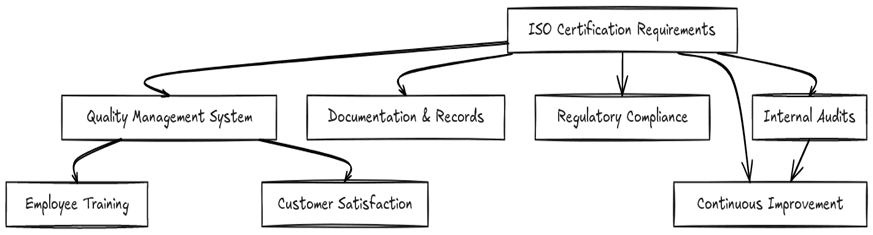
- Leadership commitment shown through policy roles resourcing and management review
- Clear scope definition including sites services exclusions and interfaces with contractors
- Context and risk review linked with practical controls and assigned responsibilities
- Document control so teams use current procedures and retain required records
- Competence control including role-based training onboarding and qualification tracking
- Operational controls for service delivery purchasing supplier evaluation and change control
- Monitoring and measurement using targets checks and trend review
- Internal audits planned and completed with findings tracked to closure
- Corrective actions with root-cause review and follow-up checks
- Evidence retention including logs reports checklists and customer feedback records
Tip: Start by mapping how work flows today then write procedures that match the flow. This keeps the system usable during peak periods.
Benefits of ISO Certifications in Lew Chew
ISO certifications deliver business value that buyers can verify through records and audit results. Below are some of the key benefits:
- Faster vendor approval through recognised evidence of controlled processes
- More consistent service delivery across shifts seasons and multiple sites
- Fewer complaints and rework through structured corrective action closure
- Stronger supplier control through approved vendor lists and incoming checks
- Safer sites and field work through planned controls for higher-risk tasks
- Better food safety assurance through hygiene monitoring allergen control and traceability
- Improved data handling through access control backup routines and incident response steps
- Clearer onboarding through role-based training and simple record expectations
- Better environmental control through waste spill readiness and site impact tracking
- Higher buyer confidence because systems are audited by an independent certification body
To get ISO certified for your operations reach out to our team at support@pacificcert.com.
Market trends and industry outlook
Okinawa’s long-range development plan, as cited in major local financial and corporate materials, projects nominal gross prefectural output reaching about ¥5.7 trillion (roughly US$ 36-37 billion). Compared to the GDP level referenced above (about ¥4.37 trillion), this implies roughly +31% nominal growth over the plan horizon.
Tourism growth is being treated as a structured economic lever, not just seasonal demand. Local roadmaps have explicitly targeted tourism revenue around ¥1 trillion, alongside high visitor volumes, which signals continued pressure on suppliers to deliver consistent service, hygiene controls and safe operations-especially in multi-site, multi-shift environments. A related trend is destination-management funding. Okinawa has moved toward mechanisms like accommodation taxation, with expected annual revenues around ¥7.8 billion, intended for tourism sustainability measures (workforce support, landscape and destination management and related priorities). This typically increases buyer attention on documented controls for waste handling, chemical storage, incident readiness and contractor management.
In practical procurement terms, this mix-higher visitor spend, larger projects and public destination initiatives-usually tightens vendor screening. Buyers increasingly want auditable evidence (procedures, logs, training records, inspections, corrective actions), which is why ISO 9001, ISO 22000, ISO 45001, ISO 14001 and ISO/IEC 27001 tend to show up more often in supplier approval checklists for hospitality, facilities, catering, logistics and IT support work.
Challenges faced in Lew Chew
Organisations often face record discipline issues during busy periods especially when staffing changes frequently. Contractor control can also be difficult when work is outsourced across multiple small vendors. Another common challenge is keeping procedures aligned with real work so teams do not treat documents as paperwork. Multi-site operators also struggle with version control when forms and checklists differ by location.
Cost of ISO certifications in Lew Chew
ISO certification cost depends on the standard scope number of sites headcount and process complexity. Audit duration increases for multi-site operations and for scopes with higher operational risk such as food operations marine work construction and large-scale logistics. Cost also depends on current readiness because a business with stable records and clear process ownership usually needs fewer correction cycles during certification audits.
For a free customised quote for your organisation contact us at support@pacificcert.com.
Timeline for ISO certification in Lew Chew
Timelines depend on scope readiness and how quickly teams can apply controls across shifts. Smaller organisations with stable processes often complete certification in a few months when scope is clear and roles are assigned early. Mid-sized organisations usually take longer due to training internal audits and corrective action closure. Multi-site operations can take additional time because consistency must be shown across locations during Stage-2.
How Pacific Certifications can help?
Pacific Certifications is an independent ABIS-accredited certification body providing third-party certification audits against ISO standards. We support organisations across hospitality logistics construction IT services food supply and manufacturing support work. Our audit approach follows the scope and sites you operate while focusing on practical evidence such as records interviews and on-site verification.
Pacific Certifications provides services including:
- Certification audits for ISO 9001, ISO 14001, ISO 45001, ISO 27001, ISO 22000, ISO 50001 and numerous other standards
- Multi-site certification for organizations operating across multiple locations in Oman or regionally
- Industry-specific expertise with auditors experienced in your sector’s unique requirements and challenges
- Surveillance audits conducted annually to verify continued compliance and system effectiveness
- Recertification audits every three years providing comprehensive system reviews
- Expert auditors combining technical standard knowledge with practical business understanding
- International recognition ensuring your certificate is accepted globally for tenders and contracts
Contact Pacific Certifications at support@pacificcert.com or visit www.pacificcert.com to discuss your certification needs and learn how we can support your quality journey.
Training and Courses
Pacific Certifications provides accredited training programs.
- Lead auditor training: helps participants learn audit planning interviewing sampling evidence review nonconformity writing and audit reporting aligned with ISO audit practice.
- Lead implementer training: supports participants in building and running a management system that matches real operations with clear roles records and controls.
Pacific Certifications provides accredited training programs. If your organization is looking for ISO training our team is equipped to help you. Contact us at support@pacificcert.com.
FAQs
Which ISO standards are most popular in Lew Chew?
ISO 9001 ISO 14001 ISO 45001 ISO 27001 and ISO 22000 are the most common.
How long does ISO certification take?
It depends on readiness scope and number of sites. Smaller scopes move faster.
Is ISO certification mandatory?
It is usually voluntary yet many buyers require it for vendor approval or tenders.
What does Stage-1 cover?
Stage-1 checks documented readiness scope and audit planning before Stage-2.
What does Stage-2 cover?
Stage-2 checks real implementation through interviews site checks and records.
Can a small business get ISO certified?
Yes. A clear scope and simple records make certification realistic for small teams.
Do we need internal audits before certification?
Yes. Internal audits are expected and help confirm readiness before Stage-2.
How often are surveillance audits done?
They are usually done annually to confirm ongoing conformity.
Can we certify more than one standard together?
Yes. Many organisations combine standards in an integrated management system.
What affects ISO certification cost the most?
Scope complexity number of sites and audit time are the biggest cost drivers.
Contact Us
If you need support with ISO Certifications in Lew Chew, contact us at support@pacificcert.com.
Read More at: Blogs by Pacific Certifications