What is ISO/IEC TR 27016:2014 Standard?

ISO/IEC TR 27016:2014 is a technical report that guides organizations in applying economic principles to information security management. Unlike prescriptive standards that focus solely on technical controls, this report introduces economic thinking into decision-making. It helps businesses assess the financial value of their information security controls, enabling them to manage cybersecurity in alignment with financial objectives.
By using this standard, companies can identify which security investments offer the greatest business value and reduce spending on ineffective or redundant controls. It is particularly useful for organizations that want to justify cybersecurity spending at the executive or board level.
To learn more or schedule an audit, contact us at support@pacificcert.com
What is the Purpose of ISO 27016?
The primary purpose of ISO/IEC TR 27016 is to provide organizations with a structured approach to making informed decisions regarding cybersecurity investments. Rather than focusing solely on technical risks or regulatory demands, the standard guides decision-makers to evaluate the economic impact of their information security strategies. This includes determining whether the financial resources used for a particular control yield adequate value, reducing unnecessary spending and prioritizing initiatives with the highest business benefit.
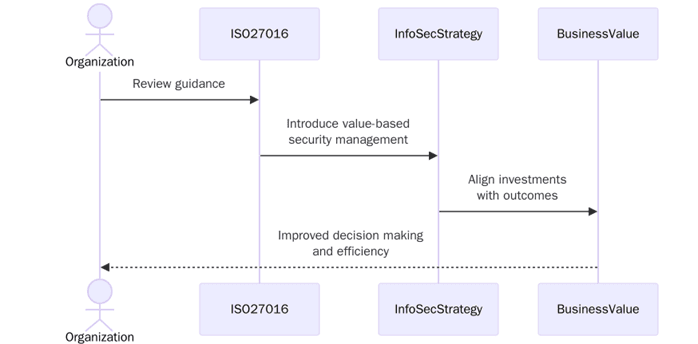
It aims to encourage a shift in thinking from compliance-focused approaches to ones grounded in economics and strategic budgeting, helping businesses improve resilience while maintaining cost control.
What is the Scope and Applicability of ISO 27016?
ISO/IEC TR 27016 applies broadly across industries and organization types. Its principles are particularly valuable for enterprises where cybersecurity decisions carry significant financial weight, such as finance, healthcare, telecommunications, defence and critical infrastructure. The report’s economic framework helps organizations assess security expenditures not only in terms of threat prevention but also in relation to business value and stakeholder expectations.
It is suitable for use by CISOs, CIOs, finance teams and risk managers who must jointly assess whether security spending delivers meaningful returns. The standard also complements ISO/IEC 27001 by providing an economic context to its implementation and control selection process.
Key Definitions
- Security Economics – The study and application of financial and economic principles to information security.
- Value-Based Security Management – Making security decisions based on their contribution to business value.
- Economic Alignment – Ensuring that security investments correspond with business priorities and available budgets.
ISO/IEC TR 27016:2014 Clauses-wise structure
Clause | Title |
| Description |
1 | Scope | Defines the application of economic principles in information security. | |
2 | Normative References | Refers to other ISO standards, including ISO/IEC 27001 and ISO/IEC 27002. | |
3 | Terms and Definitions | Explains the specific terminology used in the report. | |
4 | Principles of Economic Management of Security | Describes how financial principles apply to information security decisions. | |
5 | Implementation Considerations | Offers steps and factors to consider when applying economic thinking. | |
6 | Assessment and Measurement | Provides metrics and techniques to measure the economic value of controls. | |
7 | Integration with Existing Management Systems | Suggests how to align economic principles with existing ISMS frameworks. |
What are the requirements of ISO/IEC TR 27016:2014?
Before implementing the guidance, organizations should understand that ISO/IEC TR 27016 is not prescriptive like ISO/IEC 27001. However, to apply the report effectively, several principles must be considered. These practices bring financial accountability into cybersecurity governance. Below are some of the key requirements:
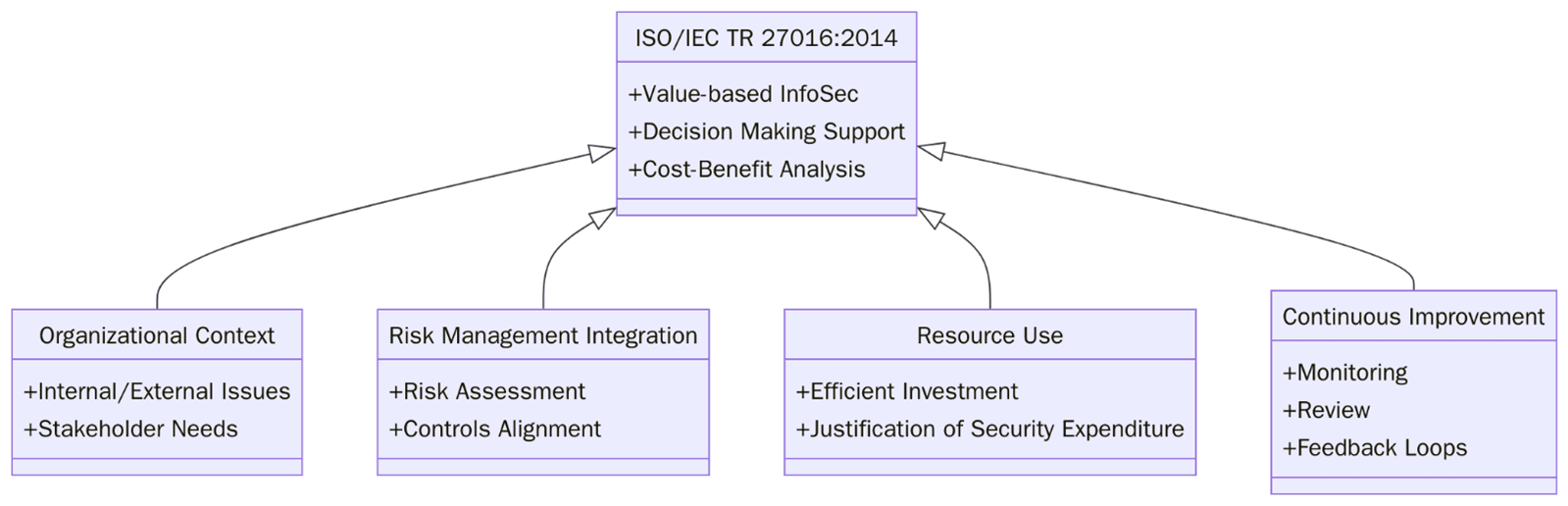
- Identify and classify information assets based on their value and associated risk.
- Apply cost-benefit analysis to compare the expense of controls with their expected benefit.
- Incorporate ROI models to measure the efficiency of security spending.
- Use metrics and KPIs to evaluate the economic impact of information security activities.
- Establish traceable decision-making that links control implementation with financial rationale.
- Train stakeholders to understand economic principles in cybersecurity planning.
- Continuously review and revise security strategies based on updated financial data and threat landscapes.
To learn more or schedule an audit, contact us at support@pacificcert.com
What are the benefits of ISO/IEC TR 27016:2014?
Before listing the benefits, it’s important to understand that this technical report doesn’t just improve how organizations manage cybersecurity. It changes how they think about it. By incorporating economic reasoning, businesses can build a more sustainable and rational security framework that adjusts with evolving risks and fiscal limitations. Below are some of the key benefits:
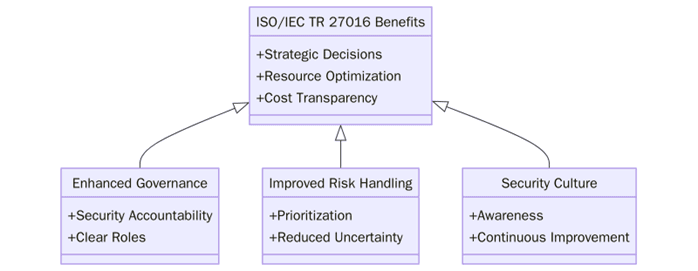
- Financially driven decision-making improves prioritization and resource use
- Reduced overspending by eliminating low-value or redundant security investments
- Better visibility into the return on security initiatives and controls
- Alignment of cybersecurity and business goals through measurable value-based planning
- Improved justification for security investments to boards and stakeholders
- Informed risk acceptance by weighing costs against potential outcomes
In the upcoming years, the use of economic models in cybersecurity has gained widespread adoption. According to industry reports, more than 60% of CISOs in large organizations now incorporate financial metrics into security planning. ISO/IEC TR 27016 has seen growing traction in the fintech, telecom and energy sectors where breach costs can be substantial.
What is the Certification Process and Procedure of ISO/IEC TR 27016?
ISO/IEC TR 27016 cannot be certified on its own, but it is often implemented alongside ISO/IEC 27001. Organizations looking to apply its principles should integrate it into their existing Information Security Management System (ISMS).
- Gap Assessment – Evaluate how current cybersecurity practices align with economic decision-making.
- Integration with ISMS – Link TR 27016 processes with your ISO/IEC 27001 framework.
- Training and Awareness – Educate stakeholders on applying economic reasoning in security planning.
- Implementation of Metrics – Introduce financial performance indicators for security controls.
- Audit Readiness – Use internal audits to validate the effectiveness of economic evaluations.
To prepare for ISO/IEC 27001 audits while integrating ISO/IEC TR 27016, contact our audit team at support@pacificcert.com
ISO/IEC TR 27016 Certification Cost
Implementing ISO/IEC TR 27016 involves indirect costs as it requires training, data analysis, and integration into management processes. Organizations already compliant with ISO/IEC 27001 may experience lower costs by building on existing systems. Additional investments may include software tools for economic modelling, stakeholder workshops, and documentation. There are no separate certification fees for TR 27016, but it contributes to a more strong and economically aligned ISMS under ISO/IEC 27001.
Certification Timeline
The time required to apply ISO/IEC TR 27016 principles depends on the maturity of your existing ISMS. Organizations already certified to ISO/IEC 27001 can usually integrate TR 27016 in 2–3 months. Businesses starting from scratch should anticipate a longer period, often 5–6 months, to align risk, financial, and governance structures. In either case, involving finance and operations teams from the beginning speeds up the process and ensures better alignment.
How Pacific Certifications Can Help?
Pacific Certifications provides audit and certification services for ISO/IEC 27001, with built-in support for ISO/IEC TR 27016 integration. While TR 27016 cannot be certified directly, we help organizations incorporate its principles into certifiable ISMS frameworks.
Our services include:
- Audit checklists focused on economic evaluation
- ISMS audits with value-based control alignment
- Training sessions for financial planning in cybersecurity
- Guidance on ROI analysis and documentation
To align ISO/IEC TR 27016 with your cybersecurity framework, contact us at support@pacificcert.com
ISO/IEC TR 27016 Training and Courses
Several training options are available for organizations looking to apply ISO/IEC TR 27016:
- Lead Auditor Training– For professionals conducting third-party audits involving financial reasoning
- Lead Implementer Training– Designed for managers integrating TR 27016 into security programs
- Internal Auditor Training– Helps internal teams prepare for audits with economic performance focus
Pacific Certifications provides accredited training programs. If your organization is looking for ISO/IEC TR 27016 training, our team is equipped to help you. Contact us at support@pacificcert.com
FAQs
What is ISO/IEC TR 27016?
It’s a Technical Report that gives guidance on making information-security decisions with an economic lens—helping organizations weigh protection options and understand the financial consequences of those choices.
Is ISO/IEC TR 27016 a certifiable standard?
No, because it’s a Technical Report (TR), it’s informative guidance rather than a certifiable requirement set. TRs are not normative documents used for certification.
Who is ISO/IEC TR 27016 written for?
Executive leadership and senior managers responsible for security decisions—think CEO, CFO, COO, CIO, CISO—so they can direct security spending alongside other business priorities.
How does ISO/IEC TR 27016 relate to ISO/IEC 27001?
ISO 27016 complements the 27001 ISMS by overlaying an economic perspective on security—supporting value-for-money choices, prioritization and resourcing.
What problems does ISO/IEC TR 27016 aim to solve?
It helps translate security risks and controls into business terms (cost, benefit, risk reduction, ROI) so boards can justify spend and compare it against competing investments.
Does ISO/IEC TR 27016 prescribe specific controls?
No, It doesn’t list controls, it guides how to make economically sound security decisions within your existing security framework (e.g., 27001).
Is ISO/IEC TR 27016 suitable for small and mid-size organizations?
Yes, ISO states the guidance applies to all types and sizes of organizations, public or private.
What are the practical benefits of using ISO/IEC TR 27016?
Clearer board-level decisions, better alignment of security budgets with risk, and easier communication of value from security initiatives to business leaders.
Is ISO/IEC TR 27016 still current?
The Technical Report was published in 2014 and remains available from ISO as guidance within the ISO/IEC 27000 family.
How do we start applying ISO/IEC TR 27016?
Map key information risks, quantify impacts and expected loss, compare control options and costs, and tie choices back to business outcomes – using the TR’s economic-decision guidance alongside your ISMS process.
Ready to get ISO 27016 certified?
Contact Pacific Certifications to begin your certification journey today!
Suggested Certifications –
Read more: Pacific Blogs