Introduction
Uzbekistan’s economy is driven by natural gas and pipelines, gold and uranium mining, cotton and textiles, agrifood and cold chain, construction and public works, logistics corridors, banking and remittances, telecom and a growing digital and data center layer. As ISO certification in Uzbekistan becomes a standard requirement for international partnerships, organizations across energy, manufacturing and logistics are adopting these frameworks. As buyers and lenders tighten scorecards in 2026 and 2027 around quality, safety, environment, energy use, data security and continuity, ISO 9001 (Quality Management), ISO 14001 (Environmental Management) and ISO 45001 (Occupational Health & Safety), give Uzbek organizations a clear way to show structured control instead of just promises.
For gas operators, EPC contractors, textile mills, warehouses and terminals, hospitals and labs, banks and payment firms, IT and cloud providers, ISO 9001 certification in Uzbekistan and integrated ISO certification programs (combined ISO 9001, ISO 14001, ISO 45001) are practical tools to defend margins, pass vendor checks and stay visible on shortlists.
Share your scope and sites in Uzbekistan with Pacific Certifications and we will help you achieve ISO certification in Uzbekistan. We will map accreditation coverage, audit timelines and Stage 1 and Stage 2 audit windows that match your project cycle, export seasons and any integrated ISO certification plans.
Economic context and industry overview
IMF and regional assessments show Uzbekistan growing fast compared to many economies. Real GDP growth was about 6.5 percent in 2024 and is projected to stay close to 6 percent in 2025 and 2026, supported by domestic demand, investment and structural reforms. Asian Development Bank and other forecasts point to GDP growth around 6.6 to 6.7 percent in 2025 and 2026 and near 6 percent in 2027, with industry and services as key drivers.
Through 2026 and 2027, capital spending is likely to focus on gas and power assets, gold and uranium projects, textile and garment clusters, agrifood processing, logistics hubs on north–south and east–west routes and new digital infrastructure. Gas trade with China, higher gold and uranium output, more joint ventures and logistics projects and new digital and AI-focused zones all point to rising expectations on reliability, safety and governance at major sites.
Why ISO certification in Uzbekistan matters: business benefits for your industry?
Large buyers, lenders and public bodies want evidence, not just policy statements. In Uzbekistan, ISO certification delivers structured proof of compliance and operational discipline so buyers and regulators can trust how work is planned, executed and monitored. These management systems help teams move faster through RFIs, RFQs and vendor portals, keep plants, projects and service lines steady, reduce incidents and base decisions on records rather than opinion.
With ISO 9001, gas companies, EPC and construction firms, textile and garment producers, agrifood processors, warehouses, terminals and service centers—as well as shared-service and digital operations—gain process control, supplier oversight and change control. For environment and safety, ISO 14001 and ISO 45001 drive disciplined control of emissions, waste, site safety, contractor work and emergency response at industrial sites, construction projects, depots and logistics yards. For digital and financial services, ISO 9001 certification for Uzbek manufacturers, logistics providers and SaaS companies often sits beside ISO/IEC 27001 and ISO 22301 when banks, fintech platforms, telecom operators and cloud providers need a structured approach to security and continuity. ISO 22000 supports agrifood, hospitality, retail and cold chain with HACCP-based systems for food safety and traceability.
Which ISO standards do Uzbek industries need most? standards by sector?
| Industry focus | Commonly requested standards | Why they matter |
| Gas, power, pipelines and fuel logistics | ISO 9001, ISO 14001, ISO 45001, ISO 50001, ISO 22301 | Process control, site safety, emissions, energy use, continuity |
| Mining, metallurgy and heavy industry | ISO 9001, ISO 14001, ISO 45001, ISO 50001 | Product quality, tailings and emissions control, worker safety |
| Textiles, garments and light manufacturing | ISO 9001, ISO 14001, ISO 45001, SA 8000 | Consistent output, environment and labor conditions |
| Agrifood, beverage, retail, hotels and cold chain | ISO 22000, ISO 9001, ISO 14001 | HACCP, traceability, waste and emissions control |
| Hospitals, clinics and laboratories | ISO 9001, ISO 15189, ISO/IEC 17025 | Patient trust, valid methods, competence in testing |
Certification process in Uzbekistan
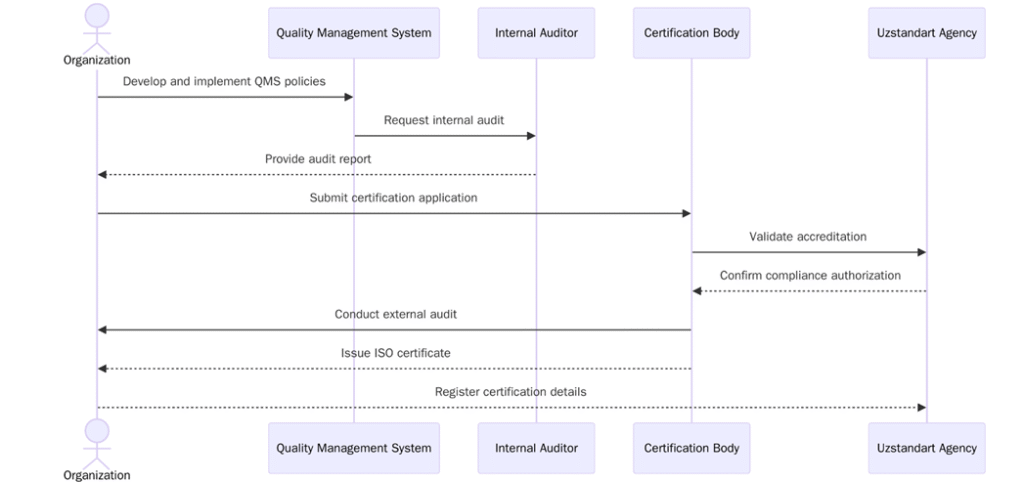
The ISO certification process in Uzbekistan begins with preparation. The ISO certification implementation roadmap should align to how work currently runs in plants, projects, offices and digital platforms so that you build audit readiness without disrupting operations. Preparation should start from how work runs today in real conditions, not on an idealized process chart. The aim is to make your system auditable without forcing people to maintain two different ways of working. Below are the steps to consider:
- List products, services, sites, headcount and high-risk processes so the scope is clear and audit time is realistic.
- Map processes end to end so handoffs, records and responsibilities are visible from suppliers through to customers and regulators.
- Set policy and measurable objectives linked to customer needs, legal duties, lender and buyer conditions and internal risk topics.
- Hold management review with KPIs, audit results, incidents or complaints, legal updates, resource issues and actions with owners and deadlines.
- Schedule Stage 1 for readiness checks and Stage 2 for implementation verification, align multi-site sampling to risk and location and agree how much can be done on site and how much remote.
- Keep permits, licenses, inspection reports, regulator and customer letters, calibration and monitoring records organized for quick verification.
What are the requirements of ISO certifications in Uzbekistan?
ISO certification requirements checklist for Uzbekistan: implementation should mirror work in gas and power assets, textile mills and workshops, agrifood sites and cold rooms, clinics and labs, call centers and data rooms so records can stand up in audits, inspections and buyer reviews. Below are the key requirements:
- Scope aligned to products or services, processes and sites, including multi-site programs and contractor parks where work is shared.
- Controlled documents and records that match practice, with clear version control, access rules and change history that users follow.
- Risk assessment with operational controls for real hazards and issues such as process safety, contractor work, HACCP, emissions, spills, cyber threats, privacy, energy use and change management.
- Standard-specific artifacts such as HACCP plans and CCP logs (ISO 22000), Statement of Applicability and risk files (ISO/IEC 27001), hazard registers and permit-to-work records (ISO 45001), aspect–impact registers and objectives (ISO 14001), energy review and energy performance indicators (ISO 50001).
- Legal and other requirements register with permits, inspections, calibrations, monitoring data and supplier compliance proofs linked to safety, environment, labor, food, health, finance, telecom and data protection for your scope.
Tip: Align your controls with Uzbek sector ministries, energy and mining rules, tax and customs requirements, food and veterinary rules, transport codes and any lender or buyer clauses in contracts.
What are the business benefits of ISO certification in Uzbekistan? competitive advantages and ROI
Certification should be used to move quicker through tenders and vendor onboarding, reassure lenders and investors and keep work steady despite currency shifts, input price changes and project pressure. The business benefits and ROI of ISO certification in Uzbekistan come from better control, fewer surprises and stronger positioning in regional value chains. Below are the key benefits:
- Faster pre-qualification in buyer portals and public procurement for energy, EPC, construction, logistics, textiles, healthcare and services.
- Fewer incidents, defects and stoppages on sites, lines, platforms and transport routes, which cuts rework, downtime and claims.
- Clear roles and skill paths for operators, technicians, engineers, controllers, HSE staff and managers across shifts and locations.
- Traceable data for investigations, recalls, warranty and cargo claims, insurance, ESG summaries and due diligence by investors and partners.
- Stronger supplier and contractor control through audits, KPIs and corrective actions across transport, maintenance, cleaning, waste, utilities, IT and cloud providers.
- Measured gains in energy use, waste, emissions, uptime and yield at plants, terminals, warehouses, workshops and data centers.
- Clearer signals of reliability and discipline for buyers in Central Asia, the Middle East, Europe and other regions who compare ISO status across vendors.
Market Trends
IMF and regional outlooks suggest that by 2026 and 2027 Uzbekistan will keep growing near 6 percent a year, supported by domestic demand, industrial expansion, strong remittances and ongoing reforms. Gas trade with China, higher gold and uranium output, more joint ventures and logistics projects and new digital and AI-focused zones all point to rising expectations on reliability, safety and governance at major sites.
These conditions are already pushing gas operators, power plants, EPC contractors, ports and 3PLs to formalize ISO 9001, ISO 14001 and ISO 45001, often with ISO 28000 and ISO 22301 for chain security and continuity. Banks, payment services, telecom and data centers see more interest in ISO/IEC 27001, ISO 22301 and ISO/IEC 20000-1, while agrifood and textile exporters use ISO 22000 and ISO 9001 to protect market access. Large energy users and utilities are also looking at ISO 50001 to control energy use and prepare for future climate and reporting expectations.
Common ISO certification challenges in Uzbekistan (and how to overcome them)
Common ISO certification challenges in Uzbekistan (and how to overcome them): local conditions can create implementation obstacles if teams lack proper support and guidance. The main hurdles usually are:
- Budgeting time and funds for certification and system upkeep when project cycles, financing and currency shifts all pull at the same time.
- Treating ISO as paperwork in some teams, which slows adoption and leaves gaps between procedure and practice.
- Shortage of trained internal auditors and process owners who can connect clauses to real risks on sites, pipelines, ports or digital platforms.
- Gaps in document control, internal audits, corrective action discipline and record keeping across multi-site and multi-vendor networks.
- Complex supply chains, joint-venture structures and outsourced processes that make it harder to gather evidence and keep controls consistent from tier 1 to tier 3.
ISO certification cost in Uzbekistan: pricing guide, factors and budget planning
ISO certification cost in Uzbekistan varies based on multiple factors. Your ISO certification price depends on headcount and risk level, number of sites (single-site vs multi-site), standards chosen (ISO 9001, ISO 14001, ISO 45001) and audit scope (on-site vs remote activities).
For many SMEs, ISO 9001 certification cost in Uzbekistan depends more on employee numbers, process complexity and single-site versus multi-site scope than on revenue alone. The same logic applies when adding ISO 14001, ISO 45001, ISO 22000 or ISO/IEC 27001.
Your proposal from Pacific Certifications will itemize Stage 1, Stage 2 and surveillance days, explain on-site versus remote activities and highlight any multi-site efficiencies so leadership and finance teams can plan clearly.
For a personalized quote on ISO 9001, ISO 14001, ISO 45001 or related ISO certification cost in Uzbekistan, contact support@pacificcert.com and request an ISO 9001 certification cost estimate for your operations in Uzbekistan.
How long does ISO certification take in Uzbekistan? timeline, milestones and schedules?
Timelines depend on document and record readiness, the speed of closing Stage 1 findings, single versus multi-site scope and whether the program is single-standard or integrated. Planning around shutdowns, project milestones, export seasons, fiscal year end and key customer audits also shapes the schedule.
A prepared single site such as one plant, depot, office, lab, data center or hospital can often move from application to decision within one audit cycle. Multi-site or integrated programs, including combined ISO 9001, ISO 14001 and ISO 45001 certification, need more sampling and planning time, especially where sites sit in different regions or involve joint-venture partners and complex logistics.
ISO standards most requested by Uzbek buyers: industry-specific selection guide
| Standard | Typical drivers in Uzbekistan |
| ISO 9001 | Supplier approval for gas and power, EPC, textiles, manufacturing, logistics and services |
| ISO 14001 and ISO 45001 | EHS control for projects, plants, depots, terminals and field teams |
| ISO 22000 | HACCP and traceability for agrifood, hospitality, retail and cold chain |
| ISO/IEC 27001 and ISO 22301 | Security and continuity for banks, fintech, telecom, cloud and public platforms |
| ISO/IEC 17025 and ISO 15189 | Competence and method control for industrial and medical laboratories |
How Pacific Certifications can help?
Pacific Certifications provides ISO certification services in Uzbekistan for gas and power, mining and metallurgy, construction and EPC, ports and 3PLs, textiles and garments, agrifood and cold chain, healthcare and labs, banks and fintech, telecom, cloud and service organizations. We offer ISO audit and certification, integrated ISO certification programs and Stage 1 and Stage 2 audit services with transparent pricing and sector expertise. We work under recognized accreditation with a team used to plant-floor, project-site and control-room realities as well as buyer and lender questions. Our certificates are accepted by procurement portals and international customers and we are recognized by ABIS.
Request your free ISO certification quote, ISO 9001 cost estimate, ISO 14001 audit plan and integrated ISO certification proposal for Uzbekistan. We will help you map Stage 1 and Stage 2 audit timelines and compliance requirements for your organization. Contact us at support@pacificcert.com or visit www.pacificcert.com.
Accredited training programs
Pacific Certifications provides accredited ISO training courses in Uzbekistan for ISO 9001, ISO 14001, ISO 45001, ISO 22000, ISO/IEC 27001, ISO 22301 and ISO/IEC 20000-1. Our ISO certification training programs develop internal auditor and implementation capability across all major sectors.
- Lead Auditor Training: for professionals who audit these systems in Uzbek organizations.
- Lead Implementer Training: for personnel who build or improve systems in plants, terminals, warehouses, hospitals, labs, utilities, banks, telecom and digital platforms.
These programs run online or on-site, depending on client needs, under ISO/IEC 17024 for personnel certification.
FAQs
How long does ISO certification take in Uzbekistan?
ISO certification timeline depends on your preparation level. A ready, single site can typically complete initial ISO certification within 4–6 months, while multi-site ISO certification or integrated programs (ISO 9001 + ISO 14001 + ISO 45001) usually require about 6–9 months because of expanded scope and sampling.
What mainly decides ISO audit time in Uzbekistan?
Headcount, risk level, number of sites, chosen standards and the mix of on-site and remote work drive audit time and sampling depth.
Can ISO audits be partly remote for Uzbek sites?
Yes, many interviews and record checks can be done remotely, with focused on-site visits reserved for higher-risk areas and physical inspections.
Which ISO standards suit gas, power and EPC in Uzbekistan?
ISO 9001 as a base, commonly combined with ISO 14001, ISO 45001, ISO 50001 and in some cases ISO 22301 or ISO 28000 for continuity and chain security.
What ISO standards fit banks, fintech and telecom in Uzbekistan?
ISO 27001 certification for information security and data protection paired with ISO 22301 for business continuity and disaster recovery, plus ISO 20000-1 for IT service management. Financial institutions and fintechs also adopt these for regulatory compliance and customer trust.
Which standards are common in agrifood and retail in Uzbekistan?
ISO 22000 with ISO 9001 and, for larger or export-focused operations, ISO 14001 to address environment and food-chain expectations.
Do you work with SMEs and NGOs in Uzbekistan?
Yes, audit time and sampling are right sized for smaller teams and NGOs while accreditation rules and impartiality are fully maintained.
What should we prepare before Stage 1 in Uzbekistan?
Scope, process maps, risk records, policy, objectives, competence records, controlled procedures and recent internal audit and management review results should be ready for Stage 1.
Are ISO certificates from Uzbekistan accepted by regional and global buyers?
Accredited ISO certificates are widely accepted, subject to each buyer’s normal supplier approval and risk-assessment process.
How do we maintain ISO certification compliance in Uzbekistan? annual requirements
Maintain your ISO certification compliance by running scheduled internal audits, closing nonconformities promptly, holding management reviews and completing surveillance and recertification audits on schedule. Pacific Certifications provides ISO certificate maintenance support and continuous improvement guidance to help ensure ongoing compliance.
Ready to get ISO certified?
Contact Pacific Certifications to begin your certification journey today!
Suggested Certifications –
Read more: Pacific Blogs