Introduction
Turkmenistan’s economy is shaped by very large natural-gas reserves, export pipelines to China, planned routes to Turkey and South Asia, petrochemicals, construction and public works, agriculture and textiles, logistics through Turkmenbashi on the Caspian and a growing services base.
By adopting ISO 9001 (Quality Management), ISO 14001 (Environmental Management) and ISO 45001 (Occupational Health & Safety), Turkmen companies can keep work predictable, reduce waste and incidents and provide clearer evidence to buyers, lenders and partners. For gas and energy projects, petrochemicals and fertilizers, construction and EPC, ports and logistics, agrifood and textiles, banks and telecom, ISO certification is a practical way to answer due-diligence questions with structured records.
Share your scope and sites in Turkmenistan with Pacific Certifications and we will map accreditation coverage, recommended audit days and Stage-1 and Stage-2 windows that suit your projects and export seasons.
Economic context and industry overview
By 2026 and 2027, Turkmenistan is expected to remain a major pipeline gas supplier to Asian and regional markets, with export volumes to China and neighbouring countries staying central to public revenue. Planned expansion of the Central Asia–China pipeline system and discussions on routes through Iran and the Caspian are likely to keep upstream, midstream and EPC activity high around gas fields, compressor stations and processing plants.
Why ISO certifications matter in Turkmenistan?
Buyers, lenders and public agencies want evidence-based systems with traceable records. ISO management systems help teams move faster through vendor reviews, keep worksites and service lines steady, cut incident rates and protect data and uptime.
The ISO 9001 supports process control and supplier oversight for gas projects, petrochemical and urea plants, construction and EPC, workshops, textile mills and service providers, ISO 14001 and ISO 45001 lift EHS discipline on construction sites, industrial zones, depots, terminals and remote project camps.
Popular ISO standards in Turkmenistan
| Industry focus | Commonly requested standards | Why they matter |
| Gas fields, pipelines and energy projects | ISO 9001, ISO 14001, ISO 45001, ISO 50001, ISO 22301 | Project control, site-safety, environmental care, energy-performance, continuity |
| Petrochemicals, urea and fertilizers | ISO 9001, ISO 14001, ISO 45001, ISO 50001 | Process quality, emissions control, worker safety, energy use |
| Construction, EPC and public works | ISO 9001, ISO 14001, ISO 45001, ISO 22301 | Works quality, EHS on sites, continuity for key assets |
| Ports, rail hubs, warehouses and 3PL | ISO 9001, ISO 14001, ISO 45001, ISO 28000 | Turnaround control, yard safety, chain-security |
| Healthcare, labs and diagnostics | ISO 9001, ISO 15189, ISO/IEC 17025 | Patient trust, validated methods, technical competence |
Certification process in Turkmenistan
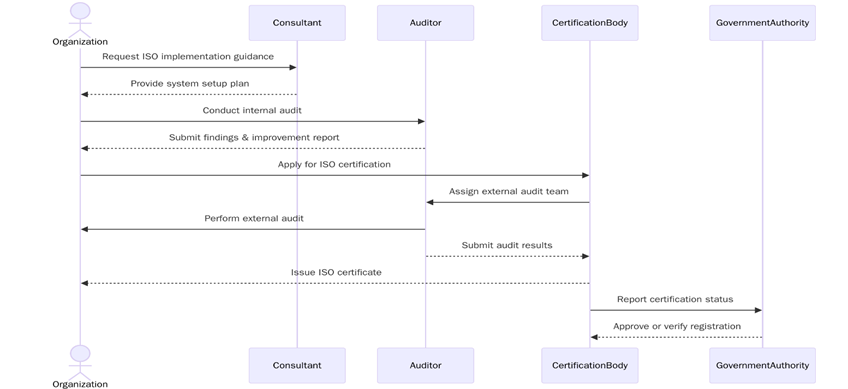
Preparation starts with an honest view of how work runs today and how evidence is captured. The aim is to make your system auditable without rebuilding daily routines from scratch. Below are the steps to consider:
- List products, services, sites, headcount and high-risk processes for a clear scope.
- Map processes end-to-end so handoffs, records and responsibilities are visible from field or plant to customer or beneficiary.
- Set policy and measurable objectives linked to customer, legal, lender and partner needs, including environment and safety where relevant.
- Assemble evidence packs for operations, maintenance, labs, IT, HSE, logistics and support functions.
- Train process owners and keep competence matrices and attendance records current, including key contractors who work under your system.
- Keep permits, licences, inspection reports, regulator letters and financing or offtake correspondence organised for quick verification.
What are the requirements of ISO certifications in Turkmenistan?
Implementation should mirror real work in gas fields and compressor stations, petrochemical and urea complexes, construction sites, textile plants, warehouses, clinics, hotels and data rooms so records hold up in audits, inspections and buyer visits. Below are the key requirements:
- Scope aligned to products or services, processes and sites, including projects, mobile crews and multi-site programmes.
- Controlled documents and records that match practice, with version-control and clear access rules for sites and head-office teams.
- Risk assessment with operational controls for actual hazards such as process-safety events, lifting and work at height, traffic, HACCP, environmental aspects, privacy and information-security, energy and change-management.
- Competence matrices and training records for process owners and high-risk roles in operations, maintenance, logistics, HSE, IT, quality and community-relations.
- Internal audits with reports, non-conformities, root-cause analysis and verified closures across sites, contractors and key suppliers.
- Management review with inputs such as KPIs, audit results, incidents or complaints, legal updates, client and community feedback and tracked decisions.
Tip: Align controls with Turkmen gas, environment, labour and health rules, with pipeline-operator requirements, with port and customs rules for Turkmenbashi and with conditions set by foreign partners, buyers and lenders.
What are the benefits of ISO certifications in Turkmenistan?
Use certification to move faster through tenders, vendor onboarding and project vetting, reassure partners and lenders and keep work steady across seasons and demand cycles. Below are the key benefits:
- Faster pre-qualification in buyer, lender and partner portals for gas, petrochemical, construction, logistics and service contracts.
- Lower incident, defect and stoppage rates on sites, lines, yards and service routes, which cuts re-work, downtime and claims.
- Clear roles and skill paths for operators, technicians, drivers, HSE staff, engineers and support teams so cover and handover are easier to manage.
- Stronger supplier and contractor control through audits, KPIs and corrective actions across transport, subcontractors, utilities, waste and IT providers.
- Measured gains in energy use, waste, emissions, uptime and yield, important where fuel and capital costs are closely watched.
Market Trends
Recent trade figures show that Turkmenistan continues to supply large gas volumes to China and is working with partners on a fourth pipeline line that could raise annual deliveries toward 65 bcm in future years. At the same time, deals to send gas through Iran to Turkey and Iraq point to broader regional energy links beyond a single export route.
Parallel investment in a new 1.3-billion-dollar urea plant at Kiyanly and earlier fertilizer complexes in Garabogaz shows a push to convert gas into higher-value exports, which raises expectations on product quality, environment, worker safety and energy-performance. Customs and transport updates also point to interest in faster logistics and port procedures on the Caspian, which supports demand for ISO 9001, ISO 14001, ISO 45001 and ISO 28000 among terminals, rail operators and 3PLs.
Challenges faced in Turkmenistan
Expectations on quality, safety, environment, social impact and data-handling are rising while many organisations still manage tight capacity, centralised decision-making and infrastructure constraints. In practice, the main hurdles are:
- Budgeting time and funds for certification and system upkeep when projects already run on tight schedules.
- Treating ISO as paperwork in some teams, which slows the use of procedures and records in daily work.
- Shortage of trained internal auditors and subject-matter specialists across remote fields, plants and regional sites.
- Gaps in document-control, internal audits, corrective-action follow-through and record-keeping across multi-site and contractor-heavy scopes.
- Travel, access and climate constraints that complicate multi-site sampling, meetings and evidence collection for audits.
What is the cost of certification in Turkmenistan?
Budgets are confirmed after scoping and reflect headcount and risk, the number and spread of sites, your standards set, whether the programme is single or integrated such as 9001+14001+45001, sampling depth for fields, plants, terminals, warehouses, clinics, hotels or branches and any field-logistics for higher-risk or remote locations.
Your proposal from Pacific Certifications itemises Stage-1, Stage-2 and surveillance days, explains on-site versus remote activities and highlights any multi-site efficiencies so leadership and finance teams can plan with clarity.
For a personalised quote, contact support@pacificcert.com.
What is the timeline for certification in Turkmenistan?
Timelines depend on document and record readiness, the speed of closing Stage-1 findings, single versus multi-site scope and whether the programme is single-standard or integrated. Planning around project milestones, shutdowns, weather, Caspian shipping windows and partner visits also affects duration.
A prepared single site, such as one gas-processing plant, urea complex, terminal, office, lab or hotel, can often move from application to decision within one audit cycle. Multi-site or integrated programmes need more sampling and planning time, especially where several regions, contractor yards or franchise locations are in scope.
Important standards often requested by buyers in Turkmenistan
| Standard | Typical drivers in Turkmenistan |
| ISO 9001 | Supplier approval for EPC vendors, gas and petrochemical projects, logistics and public contracts |
| ISO 14001 and ISO 45001 | Site-EHS control for fields, plants, construction, depots and utilities |
| ISO 22000 | HACCP and traceability for agrifood, hospitality and cold-chain |
| ISO/IEC 27001 and ISO 22301 | Security and continuity for banks, telecom and digital platforms |
| ISO 15189 and ISO/IEC 17025 | Method control and competence for medical and testing laboratories |
How Pacific Certifications can help?
Pacific Certifications audits and certifies ISO management systems for gas and energy projects, petrochemicals and fertilizers, construction and EPC, ports and logistics, agrifood and textiles, healthcare and labs, banks and telecom, universities and programme operators across Turkmenistan. We work under recognised accreditation with transparent pricing and a team used to field, plant and port realities and to buyer or lender questions on large projects. Our certificates are accepted by procurement portals and international customers and we are recognised by ABIS.
Request your ISO audit plan and fee estimate. We will help you map Stage-1 and Stage-2 timelines and evidence needs for your organisation. Contact us at support@pacificcert.com or visit www.pacificcert.com.
Accredited training programs
Pacific Certifications provides accredited training programmes in Turkmenistan for ISO 9001, ISO 14001, ISO 45001, ISO 22000, ISO/IEC 27001, ISO 22301 and ISO/IEC 20000-1.
- Lead Auditor Training: for professionals who audit these systems in Turkmen organisations.
- Lead Implementer Training: for personnel who build or improve systems in gas and petrochemical projects, construction, logistics, agrifood, hospitals, utilities, education and digital platforms.
These programmes run online or on-site, depending on client needs, under ISO/IEC 17024 for personnel certification.
FAQs
How long does certification take in Turkmenistan?
A prepared single site can usually complete the first cycle within one audit round, while multi-site or integrated programmes take longer.
What mainly decides audit time?
Headcount, risk level, number of sites, chosen standards and travel or access needs.
Can audits be partly remote in Turkmenistan?
Yes, many interviews and record checks can be done remotely, with focused on-site visits for higher-risk areas.
Which standards suit gas and petrochemical projects?
ISO 9001 with ISO 14001 and ISO 45001, often supported by ISO 50001 and ISO 22301.
What fits ports, terminals and 3PL operators?
ISO 9001, ISO 14001, ISO 45001 and ISO 28000, with ISO 22301 where continuity is important.
Which standards are common in agrifood and hospitality?
ISO 22000 with ISO 9001 and, for larger or export-focused sites, ISO 14001.
Do you work with SMEs and state-owned entities?
Yes, audit time and sampling are right-sized while accreditation rules stay intact.
What should we prepare before Stage-1?
Scope, process map, risk records, policy, objectives, competence records and recent internal-audit and management-review results.
Are certificates accepted by regional buyers and partners?
Accredited certificates are widely accepted, subject to each buyer or lender’s normal checks.
How do we keep our ISO certificate valid each year?
Maintain internal-audit and management-review cycles, close non-conformities and complete surveillance and recertification on time.
Ready to get ISO certified?
Contact Pacific Certifications to begin your certification journey today!
Suggested Certifications –
Read more: Pacific Blogs