What is General Data Protection Regulation (GDPR)?
The General Data Protection Regulation (GDPR) is a European Union law focused on data protection and privacy for individuals within the EU and the European Economic Area (EEA). It was adopted in April 2016 and came into force on May 25, 2018. GDPR governs how organizations collect, process, store and share personal data.
It applies to any entity handling the data of EU residents, regardless of where the company is based. From technology firms to healthcare providers, retailers to financial institutions, GDPR impacts businesses of all types that deal with customer or employee information.

To begin your GDPR compliance or schedule an audit, contact us at support@pacificcert.com
Purpose
The goal of GDPR is to protect the rights of individuals regarding their personal data. It gives people greater control over their information and sets clear responsibilities for organizations that process such data. GDPR also aligns data protection laws across EU countries under a single legal framework.
Scope and Applicability
GDPR applies to all organizations that:
- Operate within the EU or EEA
- Offer goods or services to EU residents
- Monitor the behavior of EU residents through websites or analytics
It covers personal data including names, identification numbers, location data, online identifiers, and data relating to physical, mental, economic or cultural identity. Even third-party vendors and cloud service providers that access or store such data must comply with GDPR obligations.
Key Definitions
- Personal Data: Any information relating to an identified or identifiable individual.
- Data Subject: The individual whose data is being processed.
- Controller: The entity that determines the purposes and means of processing personal data.
- Processor: The entity that processes data on behalf of the controller.
- Consent: Freely given, specific, informed and unambiguous agreement by the data subject to process their data.
Structure of the GDPR Regulation
| Section | Title | Description |
| 1 | General Provisions | Lays out the objectives and scope of GDPR |
| 2 | Principles | Sets out data processing rules and accountability |
| 3 | Rights of the Data Subject | Lists rights such as access, rectification, erasure and more |
| 4 | Controller and Processor Duties | Details obligations related to data handling |
| 5 | Transfers to Third Countries | Explains cross-border data transfer conditions |
| 6 | Remedies and Liabilities | Describes enforcement and penalties |
| 7 | Supervisory Authorities | Outlines powers of national data protection agencies |
| 8 | Cooperation and Consistency | Explains how authorities work together across the EU |
| 9 | Specific Processing Situations | Covers areas like employment data and public access |
What are the requirements of GDPR?
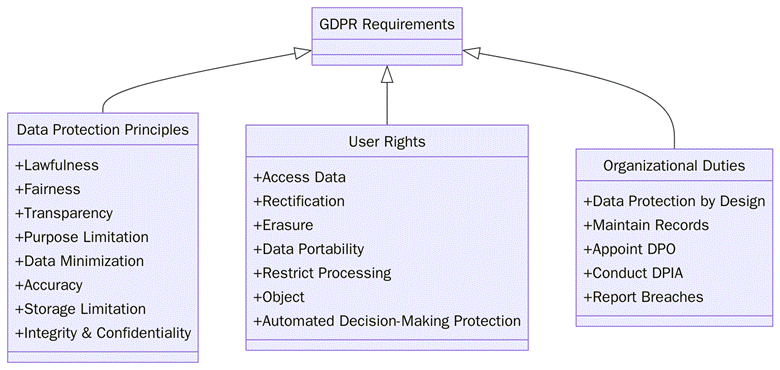
To align with GDPR, organizations must implement strict data handling and governance measures. Below are key requirements:
- Identify whether personal data is collected, stored or processed
- Appoint a Data Protection Officer (DPO) if required by scale or nature of data processing
- Maintain updated records of processing activities
- Conduct Data Protection Impact Assessments (DPIAs) for high-risk operations
- Obtain valid and informed consent before collecting personal data
- Allow data subjects to access, modify or delete their information
- Report data breaches to supervisory authorities within 72 hours
- Draft privacy notices that clearly inform users about data use
- Secure personal data through technical and organizational controls
Meeting these requirements is not a one-time task but an ongoing responsibility tied to how data is managed across operations. Organizations must review and update their practices regularly to account for changes in systems, vendors or legal interpretations. Strong internal coordination between IT, legal and operational teams helps maintain consistent compliance over time.
What are the benefits of GDPR Compliance?
Complying with the General Data Protection Regulation offers several practical and reputational advantages for organizations managing personal data within or related to the EU. Below are key benefits of aligning with GDPR:
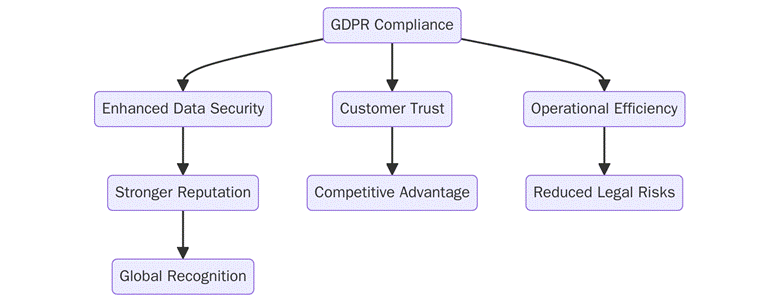
- Builds long-term customer trust through responsible data use
Organizations that implement clear policies for collecting, storing and sharing personal data are more likely to gain customer confidence. - Grants uninterrupted access to EU markets without legal blocks
GDPR compliance is a basic requirement for any organization wishing to offer services or products to individuals in the EU. - Reduces risks associated with data breaches and privacy incidents
By enforcing internal controls like encryption, access logs and breach response procedures, GDPR minimizes the chance of unauthorized access or accidental data exposure. - Improves how staff manage personal records and employee data
Internal processes around HR files, payroll data and staff communications benefit from clearer rules and defined access rights and creates a safe environment to work. - Increases clarity when working with third-party vendors and processors
This helps prevent disputes and sets clear responsibilities for everyone involved.
GDPR enforcement has intensified across the EU with record-breaking fines including €1.2 billion for Meta and €530 million for TikTok over data transfer violations. Regulators are closely watching how global platforms handle EU user data, especially when involving third-country transfers. The integration of AI technologies has raised new concerns about how personal data is used in training models, prompting updates that will soon affect high-risk AI systems.
Eligibility Criteria
GDPR applies to any organization that processes personal data of individuals located in the EU or EEA. This includes EU-based entities and foreign companies offering services to EU residents or monitoring their behavior. Even small businesses or sole proprietors handling personal data may fall within its scope. Firms that already follow ISO/IEC 27001 may find that many of their controls align with GDPR requirements.
Certification Process: GDPR
- Initial Gap Analysis – Identify where current data practices fall short
- Data Mapping – Document what personal data is collected and why
- Policy Development – Create internal privacy policies and procedures
- Consent Management – Ensure consent is valid, clear and recorded
- Training and Awareness – Educate staff on data protection responsibilities
- DPIAs and Risk Review – Evaluate processing risks and mitigation strategies
- Documentation and Records – Maintain up-to-date logs of processing activities
- Audit and Assessment – Perform internal or third-party audits for verification
Timeline for GDPR Certification
The timeline varies depending on the size of the organization, number of data systems and readiness of current records. For small firms, certification can be completed in 6 to 10 weeks. Larger entities or those starting from scratch may need up to 16 weeks. External audits and system remediation may extend the schedule.
What is the cost of GDPR Compliance?
Costs depend on data processing complexity, number of employees, system structure and readiness of existing policies. Expenses may include legal support, staff training, IT upgrades and external audit fees. Companies with strong data security frameworks may face lower costs, while others may require more preparation and guidance.
How can Pacific Certifications Help?
Pacific Certifications offers audits and assessments for GDPR alignment. We support organizations in reviewing their data processing systems and preparing the necessary documentation for GDPR compliance.
Our GDPR services include:
- Detailed gap assessments and action planning
- Review of data maps, consents and privacy notices
- Staff training for data protection awareness
- Support with DPIAs and breach response plans
- Internal audits for certification readiness
- Combined audits with ISO/IEC 27001 if required
We are accredited by ABIS and work with clients across healthcare, e-commerce, software, HR, financial services and more.
Training and Courses
Lead Auditor Training: Covers GDPR clause reviews, evidence collection and internal audit techniques.
Lead Implementer Training: Focuses on setting up data governance frameworks and breach handling procedures.
Internal Auditor Training: Designed to prepare staff to assess personal data handling and identify gaps internally.
Pacific Certifications provides accredited training programs. If your organization is looking for GDPR training, our team is equipped to help you. Contact us at support@pacificcert.com
FAQs
- Is GDPR mandatory?
Yes. If your organization handles personal data of EU residents, GDPR applies regardless of your location.
- What counts as personal data?
Any information that can identify a person directly or indirectly, such as name, email, ID number, IP address or health data.
- Can we use personal data without consent?
Only under specific legal bases such as contracts, legal obligations or vital interests. Otherwise, informed consent is needed.
- What happens if we don’t comply with GDPR?
Non-compliance can result in fines up to €20 million or 4% of annual global turnover, whichever is higher.
- Is GDPR the same as ISO/IEC 27001?
No. GDPR is a legal regulation, while ISO/IEC 27001 is a security framework. However, both support strong data protection.
Ready to get GDPR certified?
Contact Pacific Certifications to begin your certification journey today!
Suggested Certifications –
Read more: Pacific Blogs