Introduction
ISO certifications have become essential pillars for organizational excellence across India’s fast-scaling, export-linked and services-led economy. ISO Survey results for India report 57,658 ISO 9001 certificates and later reporting shows 95,007 certificates, indicating a jump of about 65% in reported certified sites under ISO 9001 within the latest survey cycle. This rise reflects stronger buyer screening in manufacturing, IT services, infrastructure delivery and supply chain operations. SME adoption is also a major driver, because India has over 6.3 crore MSME enterprises and many pursue certification to qualify for structured procurement, reduce repeat issues and standardize delivery across teams. ISO certifications support competitiveness by strengthening process control, improving audit readiness and building buyer confidence through evidence.
India’s national direction through initiatives such as Digital India, Make in India and the Viksit Bharat vision places emphasis on productivity, infrastructure, export capability and trusted digital systems. India also benefits from a mature quality infrastructure, led by bodies such as BIS and accredited conformity assessment networks supporting national credibility. India’s Global Innovation Index rank of 39 highlights progress in innovation, while also reinforcing the importance of disciplined governance and consistent operational control at organization level. ISO standards support India’s strategic goals by strengthening quality discipline, safety performance, environmental control, information security and energy management. ISO certifications offer a proven pathway to operational excellence and sustained growth.
For more information on ISO certification services, contact us at support@pacificcert.com or visit our website at www.pacificcert.com
Quick summary
ISO certifications have become essential for organizational excellence in India’s export-focused, services-and-manufacturing economy. The most requested standards include ISO 9001, ISO 14001 and ISO 45001, with strong sector demand for ISO/IEC 27001 in IT and data handling and ISO 22000 in food and hospitality supply chains. These certifications support government tenders, international contracts and market access by providing buyer-recognized evidence and repeatable controls. Online certification workflows now reduce cycle time through digital documentation, remote reviews and faster corrective action closure. Common challenges include resource allocation, documentation complexity and change management.
Economic context and industry overview
India’s economy is undergoing continued scale-up with strong services output, expanding manufacturing capacity and heavy infrastructure investment linked to transport, energy and urban development. India’s GDP is about US$ 3.91 trillion and exports of goods and services are about US$ 822 billion, reinforcing the need for standardized controls that buyers can verify across borders. Services contribute about 49.9% of GDP, while manufacturing contributes about 12.53% of GDP, reflecting a large services base alongside industrial growth. Key sectors driving the economy include IT and business services, manufacturing, construction and infrastructure, logistics and transport, pharmaceuticals and healthcare supply, food processing and agribusiness, energy and utilities and financial services. These sectors depend on supplier qualification, consistent records and controlled delivery across multi-site operations.
Two emerging sectors are tightening certification expectations. Electronics manufacturing and industrial expansion are increasing supplier audits around quality controls, traceability and safety discipline across factories and subcontractors. Digital payments, fintech, cloud adoption and large-scale IT service delivery are also expanding, raising expectations for information security controls and service continuity. Export growth adds further pressure because international buyers often ask for ISO-based evidence as part of onboarding. This mix shows growing capacity and stronger expectations for production standards, service reliability and audit-ready documentation across India’s priority industries.
Why ISO certifications matter in India?
ISO certifications deliver tangible competitive advantages in India’s evolving marketplace. Government tenders, PSU procurement and large private procurement programs frequently prefer suppliers that can show documented systems, stable records and consistent corrective action closure. ISO 9001 is often treated as a baseline for quality management, while ISO 14001 and ISO 45001 support environmental and worker safety expectations, especially in construction, manufacturing and logistics. Without certification, suppliers can face delayed onboarding, more buyer audits, lower shortlist rates and tighter payment or performance controls, which increases commercial pressure and lowers contract conversion.
International market access adds another layer. Exporters and service providers supporting global supply chains need repeatable controls, traceability records and reliable corrective action closure that stands up to audits. ISO certification supports regional and global expansion because it aligns operations with frameworks buyers already recognize, reducing friction during supplier qualification and contract renewals. It also helps overcome trade barriers tied to quality disputes, safety incidents, or inconsistent records, because the system provides structured evidence that delivery depends on controls, not individual experience.
Organizations also report practical outcomes once the system is embedded. Many see stronger workplace safety, fewer repeat nonconformities, better environmental control, improved information security for digital workflows, better energy performance in high-load facilities and higher customer satisfaction through standardized delivery. These outcomes support India’s wider direction toward export growth, infrastructure delivery, digital trust and productivity improvement, because they strengthen accountability, measurement and consistency across teams.
Important standards often requested by buyers in India
| ISO Standard | Industry/Sector | Why It Matters |
| ISO 9001:2015 | Manufacturing, IT services, construction, logistics | Often used in vendor qualification because it proves controlled processes, inspection routines, supplier evaluation and corrective action closure, supporting consistent delivery across sites, shifts and subcontractors. |
| ISO 14001:2015 | Manufacturing, construction, utilities, industrial parks | Supports waste control, chemical handling, spill readiness and monitored environmental performance, which helps in buyer ESG screening, site approvals and project onboarding conditions. |
| ISO 45001:2018 | Construction, manufacturing, warehousing, field services | Strengthens hazard controls, competence checks, contractor onboarding and incident learning, which buyers often request for project sites, factories, fleet operations and maintenance work. |
| ISO/IEC 27001:2022 | IT, BPO, fintech, SaaS, data-handling vendors | Builds access control, incident response, backup testing and supplier security checks, helping meet client audits and contract requirements where data protection assurance is mandatory. |
| ISO 22000:2018 | Food processing, dairy, catering, hospitality supply | Supports HACCP-based food safety controls, including hygiene monitoring, allergen control, temperature records, traceability and corrective actions, improving contract confidence for large buyers. |
| ISO 50001:2018 | Manufacturing, data centres, large facilities, utilities-linked sites | Supports energy baselines, monitoring, action tracking and measurable performance outcomes, improving cost control and meeting buyer sustainability expectations for high-load operations. |
| IATF 16949:2016 | Automotive manufacturing, auto components | Automotive buyers expect structured quality controls, defect prevention and traceability. IATF 16949 supports tier supplier qualification for OEM and export contracts through controlled process evidence. |
| ISO 22301:2019 | BFSI, IT services, logistics hubs, critical suppliers | Strengthens continuity planning and tested recovery routines, supporting resilience expectations where downtime affects payments, service SLAs and supply chain reliability. |
Popular ISO standards in India
ISO 9001:2015 – Quality management systems in India
ISO 9001 sets requirements for consistent processes, controlled outputs and customer satisfaction through measured performance. In India, manufacturers, construction contractors and IT services providers use ISO 9001 to standardize delivery, stabilize supplier evaluation and tighten inspection routines across multi-site operations. Export-linked suppliers use it because global buyers expect controlled documentation and corrective action closure evidence. For Indian organizations, ISO 9001 supports tender readiness, reduces repeat defects, strengthens complaint handling and improves onboarding speed through audit-ready records.
Read more: ISO 9001
ISO 14001:2015 – Environmental management systems in India
ISO 14001 helps organizations identify environmental aspects, set targets, monitor performance and maintain emergency readiness. In India, manufacturing parks, construction projects, utilities-linked sites and large facilities use ISO 14001 to control waste streams, chemical storage, spill response and disposal vendor oversight. Buyers increasingly review environmental evidence during onboarding and renewals, especially for project work and industrial supply chains. For Indian organizations, ISO 14001 strengthens monitoring discipline, improves site controls and supports contracts where environmental performance affects supplier approval.
Read more: ISO 14001
ISO 45001:2018 – Occupational health and safety management systems in India
ISO 45001 focuses on hazard identification, planned controls, competence verification and incident learning. In India, construction delivery, manufacturing operations, warehouses and field services use ISO 45001 to manage risks from lifting, vehicle movement, machinery hazards, electrical work and contractor activity. Buyer audits often focus on training evidence, supervision routines and incident reporting. For Indian organizations, ISO 45001 improves safe work methods, strengthens contractor control, reduces disruptions from incidents and supports smoother approvals for high-risk site access.
Read more: ISO 45001
ISO/IEC 27001:2022 – Information security management systems in India
ISO/IEC 27001 sets a framework to protect confidentiality, integrity and availability through risk assessment and security controls. In India, IT services, BPO, fintech, SaaS providers and shared service centers use ISO/IEC 27001 to control access rights, formalize onboarding and offboarding, test backups and run incident response workflows. Clients often require security assurance before data sharing and system integration. For Indian organizations, ISO/IEC 27001 strengthens contract trust, reduces incident exposure and improves audit outcomes in cross-border service delivery.
Read more: ISO 27001
ISO 22000:2018 – Food safety management systems in India
ISO 22000 supports food safety management using HACCP-based thinking and documented controls from receiving to distribution. In India, food processors, dairy plants, cold chain operators, caterers and hospitality suppliers use ISO 22000 to manage hygiene routines, allergen control, temperature monitoring, supplier approvals and traceability records. Large retailers and institutional buyers often request controlled food safety evidence. For Indian organizations, ISO 22000 improves inspection readiness, reduces deviations, strengthens recall preparedness and supports contract continuity through verified records.
Read more: ISO 22000
ISO 50001:2018 – Energy management systems in India
ISO 50001 helps organizations improve energy performance through baselining, monitoring, action planning and management review of measurable results. In India, manufacturing plants, data centres, large buildings and utilities-linked facilities use ISO 50001 to track consumption, reduce waste and improve maintenance practices that influence energy use. Buyers increasingly include energy performance in sustainability screening. For Indian organizations, ISO 50001 supports measurable savings, improves operational control and provides credible performance evidence for procurement and reporting needs.
Read more: ISO 50001
IATF 16949:2016 – Automotive quality management systems in India
IATF 16949 extends ISO 9001 principles for automotive manufacturing, focusing on defect prevention, process control, traceability and supplier discipline across production. In India, auto component suppliers, machining units and tier vendors adopt IATF 16949 because OEMs and global buyers often treat it as a contractual expectation. It is also relevant for export programs where rejection costs are high. For Indian organizations, IATF 16949 improves product consistency, reduces warranty risk, strengthens production documentation and supports supplier qualification for OEM supply chains.
ISO 22301:2019 – Business continuity management systems in India
ISO 22301 supports continuity planning, recovery strategies, testing and incident response governance. In India, BFSI, IT services, logistics hubs and critical suppliers use ISO 22301 where downtime affects payment operations, service SLAs and supply chain performance. It formalizes recovery objectives, crisis communication, alternate sourcing and evidence of testing. For Indian organizations, ISO 22301 improves resilience, reduces disruption impact, supports contract assurance and strengthens trust where continuity is assessed during vendor qualification.
Read more: ISO 22301
Certification process in India
- Step 1 – Gap analysis and initial assessment:
Confirm scope, sites and outsourced activities, then map current practices against the chosen ISO standard, identifying missing controls, weak records and process gaps affecting audit readiness. - Step 2 – Documentation development:
Create a structured policy and procedure library with process maps and forms, ensuring documents match real workflows and remain usable across sites, shifts and contractor teams. - Step 3 – System implementation:
Roll out controls across departments, assign owners and begin generating records for inspections, monitoring, supplier evaluation, incidents and corrective actions with consistent formats. - Step 4 – Employee training and awareness:
Deliver role-based training, verify competence for task-critical roles and maintain attendance and authorization evidence, including for contractors and temporary staff. - Step 5 – Internal audit:
Conduct internal audits across the full scope, sample evidence, interview process owners, record findings clearly and drive corrective actions to closure with effectiveness checks. - Step 6 – Management review:
Leadership reviews performance trends, audit results, incidents, customer feedback and supplier outcomes, then records decisions, resources, owners and deadlines for improvement actions. - Step 7 – Stage 1 certification audit:
The certification body reviews documented readiness, scope clarity and planning, confirming core elements exist and highlighting gaps that must be closed before Stage 2. - Step 8 – Stage 2 certification audit:
Auditors verify implementation through interviews, site checks and record sampling, focusing on operational control, competence evidence, monitoring results and corrective action closure. - Step 9 – Certificate issuance:
Once nonconformities are corrected and closure evidence is accepted, the certificate is issued for the defined scope and sites, confirming conformity to the chosen standard. - Step 10 – Surveillance and recertification:
Surveillance audits confirm ongoing conformity during the cycle, while recertification renews the certificate by verifying consistent implementation and stable records.
What are the requirements of ISO certifications in India?
Requirements vary by standard, yet most share common foundations across leadership accountability, documented processes, risk-based planning, competence management, monitoring, internal audits and corrective actions.
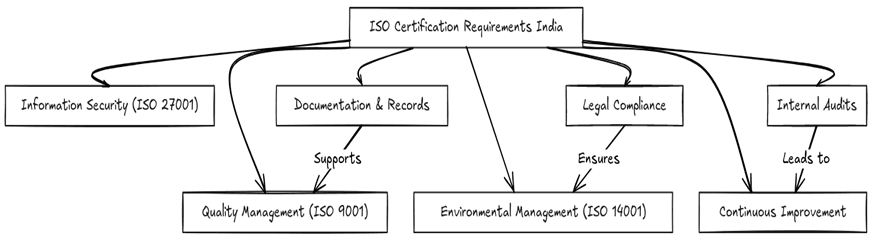
- Executive leadership engagement must set policies, approve objectives, assign responsibilities and review results, ensuring the system supports tender commitments, contract delivery and consistent outcomes across sites.
- A clear scope definition must cover locations, services, exclusions and outsourced processes, so audit sampling reflects operational reality in factories, project sites, service centers and logistics hubs.
- A structured documentation framework must include policies, procedures and work instructions that match daily workflows, remain usable and support consistent execution by teams, contractors and rotating staff.
- Risk and opportunity planning must identify operational risks, supplier risks and customer impacts, then track actions with owners and deadlines, especially for safety-critical work and continuity-sensitive services.
- Operational control mechanisms must define acceptance criteria, inspection routines, maintenance checks and emergency responses, with records proving controls are applied consistently across shifts and multi-site operations.
- Performance metrics and KPIs must be set and monitored for quality, safety, environment, security and service reliability, with reviews that reduce repeat defects, delays, incidents and complaint recurrence.
- Workforce capability development must define competence by role, deliver training, control authorizations and retain evidence for task-critical work, including site safety roles and security-sensitive system access.
- Internal auditing discipline must plan audits across the full scope, use trained auditors, verify implementation through sampling and interviews and track findings to closure with documented effectiveness checks.
- Corrective action governance must record nonconformities, identify root causes, implement fixes and verify results, ensuring closure evidence is available for buyer audits, tender renewals and certification decisions.
- Information and record control must maintain version control, retention rules and retrieval readiness, so teams always use current documents and can produce evidence quickly during audits and client reviews.
Tip: Indian organizations usually progress faster when they start with core revenue processes in manufacturing output control, project execution, logistics coordination, or IT service delivery, then expand to support functions once records and internal audits stabilize across sites.
For expert guidance on ISO certification requirements for your India business, contact us at support@pacificcert.com
Benefits of ISO certifications in India
ISO Certifications deliver measurable competitive advantages that strengthen market position, ensure regulatory compliance and drive operational excellence across all sectors in India’s evolving economy. Key benefits include:
- Improved access to international market opportunities by meeting buyer expectations for documented controls, traceability and corrective action closure across export-linked supply chains and outsourced services.
- Stronger government tender qualification because ISO-aligned systems provide auditable procedures, measurable performance evidence and clearer capability signals during prequalification and evaluation screening.
- Better operational productivity through standardized work instructions, reduced rework, fewer repeat failures and clearer process ownership that stabilizes delivery across shifts, sites and contractor teams.
- Competitive differentiation in crowded supplier markets where certification signals maturity in governance, inspection discipline and record readiness, supporting higher-value frameworks and renewals.
- Stronger risk management and compliance through structured risk assessment, supplier controls and incident handling routines that reduce disruptions and support evidence-based decision-making.
- Higher customer satisfaction through consistent service standards, systematic complaint handling, clearer response routines and measured targets that improve reliability in services and project delivery.
- Improved workplace safety through hazard controls, competence verification, contractor onboarding routines and incident learning practices that reduce injuries, downtime and repeat safety findings.
- Improved environmental sustainability through waste controls, spill readiness, chemical handling discipline and monitored performance records that support buyer screening and project onboarding expectations.
- Better financial credibility because stable controls reduce disputes, improve predictability and support confidence among lenders, insurers and contract counterparties.
- Stronger continuous improvement culture through internal audits, management reviews and KPI tracking that drive corrective actions, reduce recurrence and increase consistency over time.
- Better supply chain acceptance through supplier evaluation routines, traceable purchasing, subcontractor control and controlled onboarding that improves delivery stability across vendor networks.
- Stronger organizational reputation through visible proof of accountability, consistent records and verified controls that reduce friction during client audits and contract renewals.
Market trends and industry outlook
India’s ISO certification market grows at 12-15% annually, with 500,000+ certifications across standards, driven by manufacturing PLI and digital economy push. Globally, India ranks top-5, supported by 50+ NABCB bodies and rising SME adoption amid $1T export target by the end of this decade. Emerging standards like ISO 27001 (cybersecurity for $250B digital economy) and ISO 50001 (energy for net-zero) gain traction, tied to Digital India and renewable missions. Pharma and auto sectors see 20% yearly uptake. In textiles/food/auto, regulatory pressures like FSSAI/BIS inspections drive demand; 60% exporters certified, with government mandating ISO for MSME loans.
Emerging standards are shaping decision-making in fast-scaling sectors. ISO/IEC 27001 is gaining priority as cloud adoption expands, vendor-managed access becomes common and clients demand clearer controls for access rights, backups and incident response. ISO 50001 is also rising in relevance because factories, data centres and large facilities need measurable energy performance and documented improvement actions. AI governance expectations are also entering procurement discussions for organizations using automation and analytics and ISO 42001-style governance thinking is increasingly used as a reference point for responsible management of AI-driven workflows.
Sector-specific demand remains decisive. Manufacturing and automotive supply chains are pushing stronger adoption of ISO 9001 and IATF 16949, because defect prevention, traceability and supplier discipline affect export acceptance and OEM approvals. Food processing and institutional catering continue to raise ISO 22000 demand as buyers tighten hygiene, allergen control and traceability checks. Infrastructure and logistics projects keep ISO 45001 and ISO 14001 relevant because contractor safety and site controls are evaluated through records, training evidence and corrective action closure in both public and private procurement.
Challenges faced in India
Organizations in India, especially SMEs, often struggle to allocate time, people and budget for system build-out while meeting daily delivery targets and cash-flow priorities. Documentation can become complex when teams build procedures that do not match operational reality, which leads to weak adoption and missing records during audits. Change management resistance slows progress when staff treat ISO routines as additional work rather than delivery discipline. Maintaining ongoing compliance requires regular internal audits, management reviews and corrective action closure, yet many organizations lack dedicated quality personnel. Cost considerations also influence pace, especially for multi-site scopes where training, audit time and ongoing surveillance add workload.
Cost of ISO certifications in India
ISO certification costs vary based on organization size, selected standard, number of sites and process complexity, with multi-site operations usually requiring more audit time because auditors sample evidence across locations, shifts and key processes. High-risk activities, subcontractor-heavy delivery and weak record discipline can also increase audit time and corrective action workload.
Cost components typically include consulting support where used, training, certification audit fees, internal resource time, travel where applicable, plus surveillance and recertification audits. For a free customized quote for your organization, contact us at support@pacificcert.com
Timeline for ISO certification in India
Timeline depends on readiness, scope clarity and how quickly stable records are created and maintained. Small organizations often complete certification in 3 to 6 months when scope is focused and leadership supports implementation. Medium organizations typically need 6 to 12 months due to cross-department rollout, training coordination and corrective action closure. Large or complex organizations may take 12 to 18 months, especially where multi-site operations require consistent implementation, broader Stage 2 sampling and time to stabilize records across shifts and locations.
How Pacific Certifications can help?
Pacific Certifications is an ABIS accredited certification body providing third-party certification audits against ISO standards. We support organizations in India across manufacturing, construction, logistics, IT services, food supply chains, healthcare suppliers and multi-site operations, with audits focused on practical evidence, interviews and on-site verification aligned to your scope and operational realities. Pacific Certifications provides services including:
- Certification audits for multiple ISO standards
- Multi-site certification for organizations operating across several locations
- Industry-specific expertise with auditors experienced in your sector
- Surveillance audits conducted annually to verify continued compliance
- Recertification audits to renew certification at the end of the cycle
- Expert auditors combining technical knowledge with practical business understanding
- International recognition supporting tenders and contract acceptance
Free ISO certification quote India- support@pacificcert.com or visit www.pacificcert.com to discuss your certification needs and learn how we can support your quality journey.
Accredited training programs
Pacific Certifications also provides accredited training programs that build practical capability beyond certification, especially for internal auditing, system ownership and process-level control. Training helps teams apply ISO requirements in real workflows, improve record discipline and strengthen readiness for certification audits without creating systems that feel detached from daily work.
- Lead auditor training: Covers audit planning, interviewing, sampling, evidence evaluation, nonconformity writing and reporting.
- Lead implementer training: Covers how to design, run and maintain a management system that matches real operations.
Training is available for ISO 9001, ISO 14001, ISO 45001, ISO/IEC 27001, ISO 22000, ISO 50001, IATF 16949 and ISO 22301, delivered through online, in-person, on-site and blended formats based on team size and operational needs.
Contact us at support@pacificcert.com for training program details and scheduling.
FAQs
Which ISO standards are most popular in India?
ISO 9001, ISO 14001, ISO 45001, ISO/IEC 27001, ISO 22000, ISO 50001, IATF 16949 and ISO 22301 are widely requested, aligned with manufacturing, IT services, infrastructure delivery, food supply chains and export procurement.
Which ISO standards are most popular in India?
ISO 9001, ISO 14001, ISO 45001, ISO/IEC 27001, ISO 22000, ISO 50001, IATF 16949 and ISO 22301 are widely requested, aligned with manufacturing, IT services, infrastructure delivery, food supply chains and export procurement.
Is ISO certification mandatory in India?
ISO certification is typically voluntary, yet many tenders and buyer onboarding programs treat specific standards as required for vendor approval, site access, or contract renewal in higher-risk sectors.
What are the costs involved?
Costs depend on scope, sites and selected standards. Typical components include training, internal resource time, certification audit fees, travel where applicable, plus surveillance and recertification audits during the cycle.
Can small businesses get ISO certified in India?
Yes. SMEs often succeed by defining a focused scope, keeping documentation practical, stabilizing record routines early and completing internal audits before the Stage 2 audit.
How does ISO certification help win government tenders in India?
Certification improves tender credibility by proving controlled processes, stable records and consistent delivery evidence. It supports faster prequalification, reduces repeat audits and strengthens evaluation outcomes where governance matters.
Contact Us
If you need support with ISO Certifications in India, contact us at support@pacificcert.com.
Read More at: Blogs by Pacific Certifications