Accredited Educational Reference & Implementation Guide
The global business landscape demands absolute operational consistency, regulatory alignment, and a culture of continuous improvement. Secure your operational excellence with our globally recognized frameworks.
ISO 9001 is the internationally recognised standard for Quality Management Systems (QMS), developed by the International Organization for Standardization. It sets out the requirements for building a structured, process-driven approach to delivering consistent quality across any industry, any size of organisation, anywhere in the world.
The current version, ISO 9001:2015, places particular emphasis on risk-based thinking, leadership commitment, and continual improvement, ensuring your QMS actively drives business performance rather than sitting on a shelf as a compliance document.
With over one million certificates issued in more than 180 countries, it is the most widely adopted management system standard globally and a benchmark that customers, procurement teams, and regulators trust. The standard is currently under revision, with ISO (International Organization for Standardization), ISO 9001:2026 expected to replace the 2015 version and reflect the realities of today’s digital, AI-driven, and sustainability-conscious business environment.
Get in touch with Pacific Certifications today for a seamless, transparent path to accredited registration. Our global experts are available 24/7 to support your operational needs.
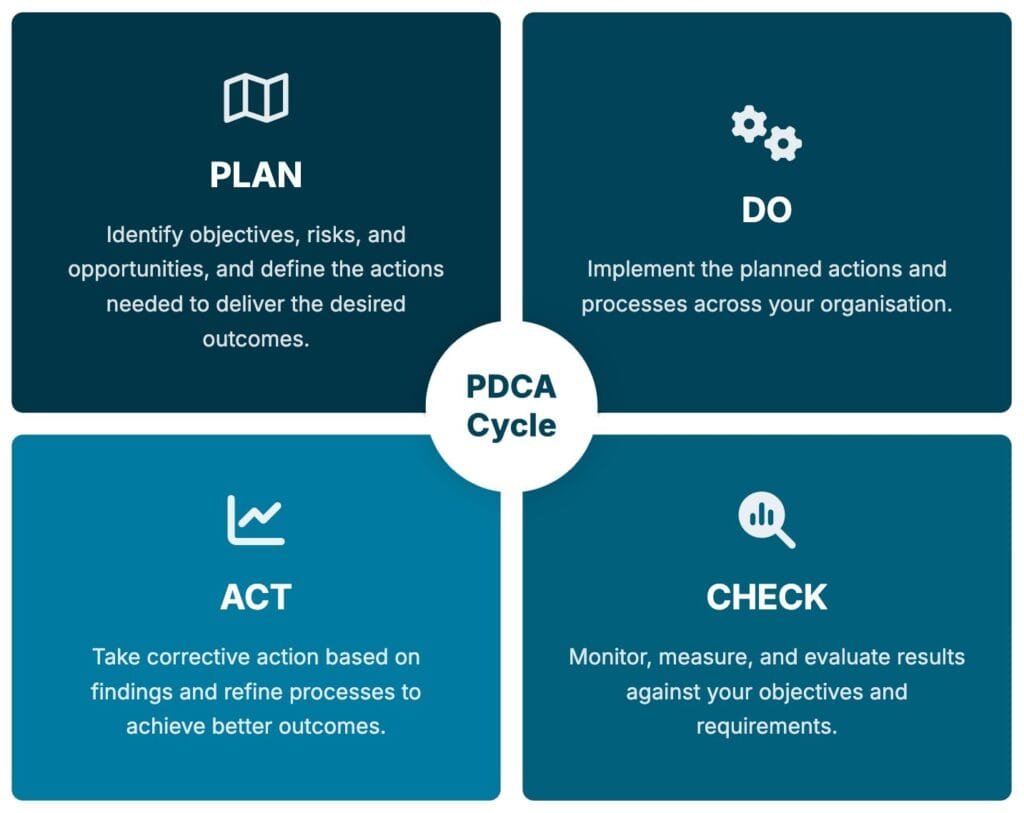
The ISO 9001 PDCA (Plan-Do-Check-Act) cycle is the operational backbone of this Standard, providing a simple yet powerful framework for managing processes and driving continual improvement. It ensures your Quality Management System evolves continuously rather than remaining static.
From first audit to final certificate, our expert auditors support you at every stage with clarity, efficiency, and globally recognised accreditation.
Receive an independently audited, globally recognised ISO 9001 certificate through our transparent two-stage audit process.
Build internal competence with our ISO 9001 training programmes, designed for all levels from awareness to lead auditor.
Hold multiple ISO certifications? We combine audits into a single streamlined programme, saving you time and resources.
Identify gaps and non-conformities before your formal audit, so there are no surprises on certification day.
The ISO 9001 changes introduced across successive versions reflect how modern businesses approach quality, risk and accountability.
| Parameter | ISO 9001:2008 | ISO 9001:2015 | ISO 9001:2026 |
|---|---|---|---|
| Structural Template | Individual, isolated standard format with no common framework across ISO standards | Annex SL harmonized ten-clause structure, enabling seamless integration with other ISO standards | Further alignment expected with digital and AI-driven process frameworks. |
| Risk Approach | Reactive corrective actions taken after issues arise | System-wide risk-based thinking embedded across all processes and planning activities. | Proactive risk intelligence incorporating digital risk, supply chain resilience, and AI-related uncertainties. |
| Governance | Delegated to a designated Management Representative | Broader governance expectations covering sustainability, ethical practices, and organisational resilience. | Direct accountability placed on top management and executive leadership. |
| Documentation | Mandatory documented procedures and quality manual required | Flexible, outcome-focused documentation based on organisational context | Smart documentation supported by digital records, automation, and real-time data |
| Focus Area | Product and process compliance | Customer value, continual improvement, and strategic alignment | Sustainability, digital transformation, and long-term organisational resilience |
These ISO 9001 Principles serve as the structural philosophy informing every clause and requirement of the standard.
Meet and consistently exceed expectations. Aligning internal workflows with customer satisfaction drives brand retention and growth.
Executive leaders establish unified direction. Direct accountability creates a culture where employees engage in achieving objectives.
Empowering and valuing personnel at every layer of the workforce enhances organizational capabilities and efficiency.
Managing interconnected workflows as a logical, cohesive system produces predictable results and lowers process redundancies.
Sustainable organizations maintain an ongoing focus on performance optimization, proactive problem solving, and error reduction.
Strategic choices grounded in objective analysis of audited metrics yield more predictable outcomes than speculative planning.
Cultivating mutually beneficial, collaborative alliances with suppliers, sub-contractors, and strategic stakeholders stabilizes supply chain velocity and protects operating margins.
The standard operates within a structural 10-clause framework, where Clauses 4 through 10 define the formal requirements evaluated for certificate registration.
| Clause | Title | Operational Scope & Requirement Objective |
|---|---|---|
| Clause 4 | Context of the Organization | Map internal/external issues, track stakeholder needs, define QMS scope. |
| Clause 5 | Leadership | Demonstrate executive commitment, author Quality Policy, foster quality culture. |
| Clause 6 | Planning | Isolate risks, pursue commercial opportunities, set measurable quality goals. |
| Clause 7 | Support | Provide infrastructure, track workforce competence, manage documented data. |
| Clause 8 | Operation | Govern core product delivery lines, manage external vendors and evaluation. |
| Clause 9 | Performance Evaluation | Monitor process metrics, track customer satisfaction, conduct internal audits. |
| Clause 10 | Improvement | Systematically log nonconformities, implement corrective actions, drive optimization. |
The ISO 9001 requirements establish the core controls for quality planning, process management, performance evaluation and continual improvement within a Quality Management System.
Everything you need to prepare for ISO 9001 certification (pdf) in one place.
The ISO 9001 Steps to certification combine effective system development, clearly defined processes and procedures and rigorous auditing.
Submit your application and tell us about your organisation, scope, and industry.
Your consultants or internal auditors assess your current systems against ISO 9001 requirements and identify areas to address.
A documentation review to confirm your QMS is ready for the on-site assessment.
Our auditor evaluates whether your QMS is fully implemented and effective in practice.
Upon successful completion, your ISO 9001 certificate is issued, valid for three years.
Annual surveillance audits keep your certification current, followed by recertification at the end of the three-year cycle.
For a standard enterprise, the ISO 9001 Certification Timeline is typically structured across a focused ten-week implementation and audit schedule:
| Week | Activity Description | Core Milestones & Focus Areas |
|---|---|---|
| Week 1 | Application & Analysis | Submit profiles and define QMS scope. |
| Week 2 | Gap Analysis | Evaluate existing workflows against standard clauses. |
| Weeks 3-4 | QMS Implementation | Deploy processes, track competence, and execute internal reviews. |
| Weeks 5-6 | Stage 1 Audit | Lead auditor evaluates written records to confirm baseline readiness. |
| Weeks 7-8 | Stage 2 Audit | Exhaustive process evaluation to verify compliance. |
| Week 9 | Technical Review | Correct minor gaps and finalize the technical review. |
| Week 10 | Certificate Issuance | Receive your accredited ISO 9001 certificate upon successful completion of the certification assessment. |
Note: The timeline provided is tentative and may vary depending on factors such as the organization’s size, scope, number of locations, documentation readiness, availability of personnel, assessment findings, and completion of corrective actions.
ISO 9001 certification cost varies from organisation to organisation. Pricing is determined by your organisation’s size, number of locations, industry complexity, and whether you are integrating multiple ISO standards under a single audit programme.
At Pacific Certifications, we offer transparent, competitive pricing with no hidden charges. Contact us for a tailored quote or use our free cost calculator to get an instant estimate.
ISO 9001 certification is no longer optional for businesses that want to grow. In 2026, customers expect proof of quality, not just a promise. Certified organisations win more contracts, retain more clients, and operate more efficiently. Those without certification are increasingly being overlooked. Getting certified now puts your business in the strongest possible position. With the 2026 revision of the standard on the horizon, certified organisations are already ahead of the curve.
We provide deep, sector-specific auditing aligned directly with your daily operations.
Upskill your internal teams with our certified training pathways.
For professionals looking to conduct and lead ISO 9001 audits with confidence and internationally recognised credentials.
For those responsible for designing, implementing, and maintaining a QMS within their organisation.
For teams and individuals who need a clear, practical understanding of ISO 9001 and what it means for their day-to-day work.
We are not just a certification body, we are the partner that helps your organisation earn trust, improve performance, and grow with confidence.
Accredited by the ABIS (Accreditation Board for International Standards), our certificates are accepted by clients, regulators, and procurement bodies worldwide.
Our auditors bring sector-specific knowledge to every engagement, ensuring your audit is relevant, thorough, and conducted by someone who understands your business.
We operate globally with the capability to conduct both remote and on-site audits, delivering consistent, high-quality certification services wherever you are.
From your first enquiry to your final certificate, we keep things clear, efficient, and tailored to your organisation — no unnecessary delays, no hidden costs.
ISO 9001 certification is an independent, third-party confirmation that your organisation's Quality Management System meets the requirements of the internationally recognised ISO 9001 standard. It demonstrates to customers, partners, and regulators that your business delivers consistent quality — and that this has been verified by an accredited certification body, not just claimed.
Most organisations achieve ISO 9001 certification within 3 to 6 months. The timeline depends on the size of your organisation, the complexity of your processes, and how developed your existing quality systems are. Our team will give you a realistic timeline from the very first conversation.
Certification costs are based on your organisation's size, number of sites, industry, and audit scope. At Pacific Certifications, we provide transparent, competitive pricing with no hidden charges. Contact us or use our free cost calculator for a tailored estimate specific to your organisation.
ISO 9001 certification is voluntary in most industries. However, many clients, government bodies, and procurement teams require it as a condition of doing business. In practice, not being certified can cost you contracts and close doors that certification would otherwise open.
ISO 9001:2015 is the current valid version of the standard. ISO 9001:2026 is an upcoming revision expected to reflect modern business realities including digital operations, AI-assisted processes, and sustainability requirements. Organisations certified under ISO 9001:2015 will be guided through the transition when the new version is formally published.
ISO 9001 certificates are valid for three years. During this period, annual surveillance audits are conducted to confirm your QMS remains effective and compliant. At the end of the three-year cycle, a full recertification audit is carried out to renew your certificate.
Yes. Pacific Certifications offers fully remote audits using structured, accreditation-compliant methodologies. Remote audits are particularly suitable for office-based, technology, and service-sector organisations. On-site audits remain available and may be required depending on your industry or audit scope.
Absolutely. ISO 9001 is designed to be scalable and is equally applicable to small businesses, mid-sized companies, and large enterprises. The standard adapts to your context — what matters is that your QMS is proportionate, documented, and effective for the size and nature of your operations.
A failed audit does not mean the process ends. If non-conformities are identified during the audit, you will be given a defined timeframe to address them and provide evidence of corrective action. Our auditors work with you constructively throughout the process — the goal is to help you achieve certification, not to find reasons to withhold it.
Yes, and it is highly recommended. ISO 9001 shares a common framework with ISO 14001 (Environmental Management), ISO 45001 (Occupational Health and Safety), and ISO/IEC 27001 (Information Security), among others. This means multiple standards can be audited together in an integrated programme, saving time, reducing duplication, and giving your organisation a more complete management system.
Get in touch with us today. Complete the form and we’ll be happy to assist you.
This will close in 20 seconds
WhatsApp us