Introduction
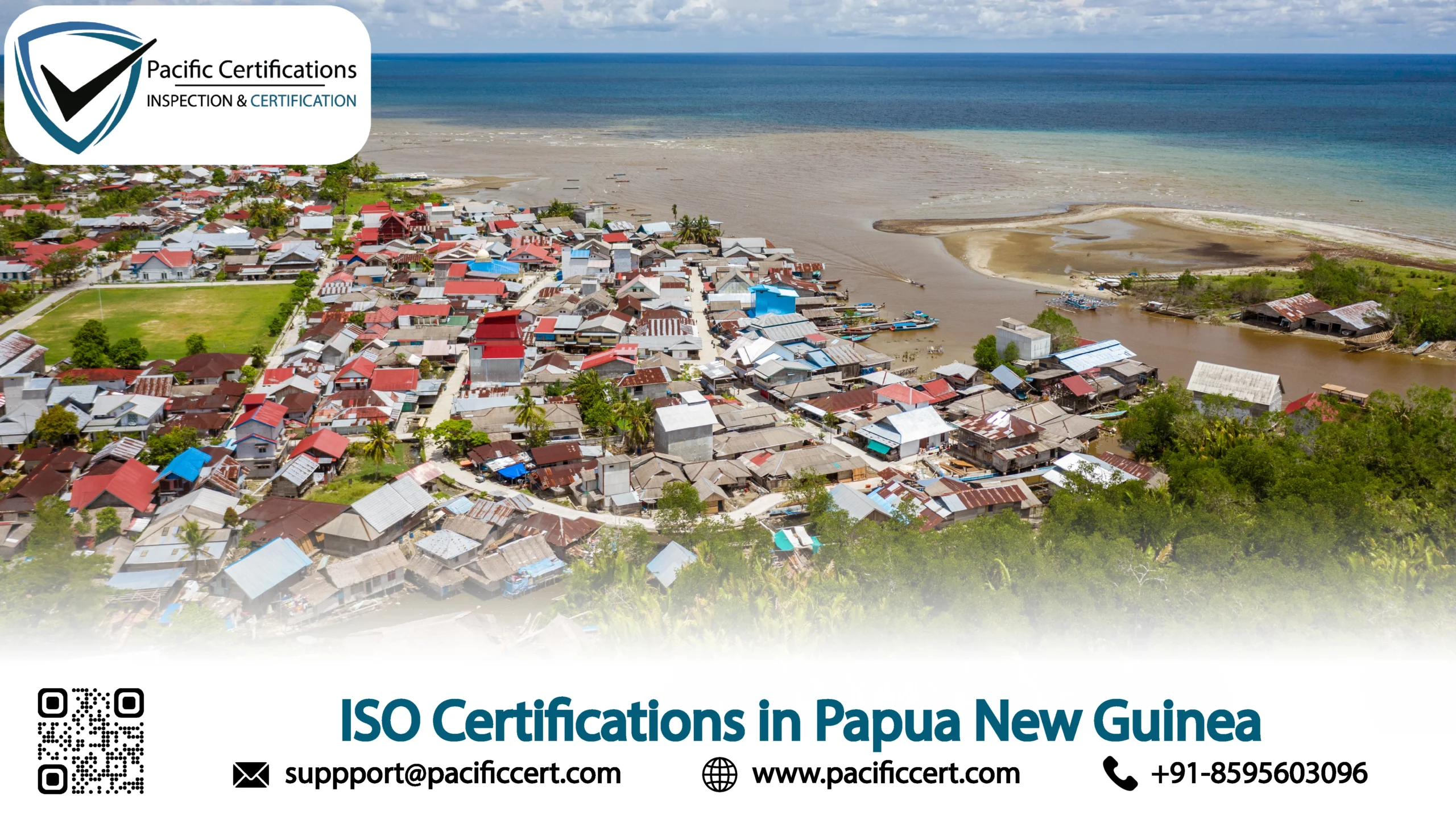
Papua New Guinea has an economy shaped by resources, project-led contracting, logistics, agriculture supply, construction, public services and growing digital and support services. Many buyers, including large project owners, EPC contractors, government-linked entities and international partners, expect suppliers to show controlled processes, safe work practices and traceable records, especially when delivery happens across remote sites, shifting crews and multiple subcontractors.
ISO certification helps organisations in Papua New Guinea prove that work is planned, checked and improved through a documented management system. It supports consistent outcomes in purchasing, supplier evaluation, job execution, inspection routines, incident reporting and corrective actions, while giving buyers a familiar basis for supplier approvals and tenders.
For more information on ISO certification services, contact us at support@pacificcert.com, or visit www.pacificcert.com.
Quick Summary
ISO certifications help organisations in Papua New Guinea align daily operations with recognised management system standards. The most requested standards include ISO 9001 (quality management), ISO 14001 (environmental management), ISO 45001 (occupational health and safety), ISO/IEC 27001 (information security), ISO 22000 (food safety), ISO 50001 (energy management) and ISO 13485 (medical devices quality management), where applicable. These certifications support buyer approvals, tender readiness, consistent delivery and controlled records across teams and sites.
Economic context and industry overview
Papua New Guinea’s total economic output is estimated at about US$ 32.5 billion. The economy is strongly linked to natural resources and large projects, while many households remain connected to agriculture and local supply chains. Sector splits commonly referenced in economic summaries place agriculture at about 22.1% of GDP, industry at about 42.9% and services at about 35%.
Trade data also shows how resource and commodity flows shape supplier markets. Recent export profiles list leading export categories as petroleum gas (about US$ 5.36B), gold (about US$ 2.53B), copper ore (about US$ 1.26B), crude petroleum (about US$ 838M) and palm oil (about US$ 684M). Tourism activity exists and it is often discussed alongside services and destination development. A U.S. government commercial guide cites tourism export value around US$ 183 million and a GDP contribution figure around 2.1% (pre-disruption benchmark).
Why ISO certifications matter in Papua New Guinea?
ISO certifications matter because they convert day-to-day operations into auditable evidence. When a buyer outsources construction, maintenance, transport, warehousing, catering, camp services, security, IT support, or inspection work, they want proof that delivery does not depend on individual experience. ISO helps define how work is done, how risks are controlled, how changes are managed and how issues are closed through corrective actions.
ISO systems are also practical for project-based delivery. They support contractor controls, toolbox talks, permit routines, inspection records and incident reporting, which are often required in client site rules. For organisations operating across several sites or provinces, ISO helps keep one controlled way of working, while still allowing site-specific controls for local risks.
Important standards often requested by buyers in Papua New Guinea
| ISO Standard | Industry or sector | Why buyers request it |
| ISO 9001 | Contractors, services, logistics, manufacturing support | Consistent delivery, supplier control, inspections, complaint handling |
| ISO 14001 | Resources supply, construction, logistics, camps, facilities | Waste controls, spill readiness, chemical storage, site impact management |
| ISO 45001 | Construction, maintenance, transport, field services | Hazard control, incident reporting, safer work methods, contractor controls |
| ISO/IEC 27001 | IT services, payroll, shared services, data handling | Access control, backups, incident response, vendor security checks |
| ISO 22000 | Catering, food supply, food logistics, hospitality | Hygiene controls, allergen handling, traceability, monitoring records |
| ISO 50001 | Large facilities, energy-intensive operations, processing sites | Energy baselines, monitoring, improvement actions, performance review |
| ISO 13485 | Healthcare supply, packaging, servicing support | Traceability, validation, controlled documentation for buyer approvals |
Popular ISO standards in Papua New Guinea
ISO 9001 in Papua New Guinea (Quality management)
ISO 9001 helps businesses build consistent outcomes through defined processes and measurable controls. It supports clearer workflows for purchasing, supplier evaluation, service delivery, inspection routines and complaint handling. For service businesses, it helps standardise customer onboarding, job execution, service reporting and closure records. For product-based operations, it supports control over inspection criteria, traceability and corrective actions when defects occur. ISO 9001 is also useful when buyers ask for proof that quality is controlled across shifts and locations, not dependent on individual experience.
Read more: ISO 9001
ISO 14001 in Papua New Guinea (Environmental management)
ISO 14001 helps organisations control environmental aspects tied to operations, facilities and suppliers. In practice, this includes waste segregation, chemical storage controls, spill response routines and monitoring of environmental performance. For construction, logistics and project sites, it supports structured routines for storage, disposal, site checks and incident reporting. ISO 14001 also helps during buyer audits, where environmental practices and evidence are reviewed as part of supplier approval.
Read more: ISO 14001
ISO 45001 in Papua New Guinea (Occupational health and safety)
ISO 45001 supports safer work conditions by turning hazard control into a planned system with training and evidence. It helps identify risks such as slips and falls, lifting injuries, equipment hazards, electrical risks, driving risks and contractor risks, then put controls in place through procedures and competence checks. It also supports incident reporting, corrective actions and emergency readiness. For businesses with field work, maintenance activity, or high-risk tasks, ISO 45001 helps ensure safety routines are consistent and reviewed.
Read more: ISO 45001
ISO/IEC 27001 in Papua New Guinea (Information security)
ISO/IEC 27001 is used to protect information across confidentiality, integrity and availability. For businesses using online systems, payment tools, customer databases, HR platforms, or cloud services, ISO/IEC 27001 helps control access rights, secure onboarding and offboarding, incident response steps, supplier checks and backup routines. It is especially useful when partners request evidence for data protection, vendor risk handling and secure processing of sensitive information.
Read more: ISO 27001
ISO 22000 in Papua New Guinea (Food safety management)
ISO 22000 supports food safety management using HACCP-based thinking and documented controls. It helps food businesses manage hazards from receiving and storage through preparation, packing and service. Controls commonly include hygiene routines, allergen awareness, temperature monitoring, supplier approval, traceability records and corrective actions for deviations. For catering, food processors and food supply operations, ISO 22000 supports consistent food safety routines and stronger readiness for inspections and client audits.
Read more: ISO 22000
ISO 13485 in Papua New Guinea (Medical devices quality management)
ISO 13485 is used by organisations involved in medical device related manufacturing, packaging, servicing, or supply. It supports controlled documentation, traceability, validation steps and quality controls tied to patient safety expectations. For businesses that supply parts or services into healthcare and medical device supply chains, ISO 13485 helps meet buyer approval requirements through structured process control and records.
Read more: ISO 13485
ISO 50001 in Papua New Guinea (Energy management)
ISO 50001 helps organisations manage energy use through monitoring, planning and improvement actions. It supports building an energy baseline, tracking consumption, identifying major energy uses and improving performance through maintenance routines and operational controls. For facilities with high electricity demand, ISO 50001 can support cost control and planned energy performance improvement, while keeping records that can be reviewed during management reviews and audits.
Read more: ISO 50001
Certification process in Papua New Guinea
Step 1 – Gap review and initial assessment:
Confirm your scope, sites, products or services and key processes, then identify gaps against the selected ISO standard (including outsourced processes, such as subcontracted transport, cleaning, security, or IT).
Step 2 – Documentation build:
Prepare policies, procedures, work instructions and controlled forms that match real operations; avoid generic documents that teams will not use.
Step 3 – System roll-out:
Implement controls across departments and locations; assign process owners, define responsibilities and set record routines that teams can maintain during peak periods.
Step 4 – Training and awareness:
Provide role-based training for employees and contractors; confirm competence for task-critical roles and retain training evidence (attendance, evaluations, authorisations).
Step 5 – Internal audit:
Conduct internal audits across the full scope; record findings clearly, then track corrective actions to closure with evidence.
Step 6 – Management review:
Management reviews audit results, performance trends, incidents, customer feedback, supplier performance and improvement actions, and records decisions, owners and timelines.
Step 7 – Stage-1 audit:
The certification body reviews documented readiness, scope and audit planning, and the organization addresses any gaps before Stage 2.
Step 8 – Stage-2 audit:
Auditors verify implementation through interviews, site checks and record review across key processes (purchasing, delivery, inspections, HSE controls, corrective actions).
Step 9 – Certificate issuance:
After teams close nonconformities and submit corrective action evidence, the certification body issues the certificate for the defined scope.
Step 10 – Surveillance and recertification:
Surveillance audits verify continued conformity; recertification renews the certificate at the end of the cycle.
What are the requirements of ISO certifications in Papua New Guinea?
ISO requirements vary by standard, yet most organisations prepare around a shared management system structure. The key is to link controls with real operational risks and keep records that prove consistency across shifts and sites. Below are some of the key requirements:
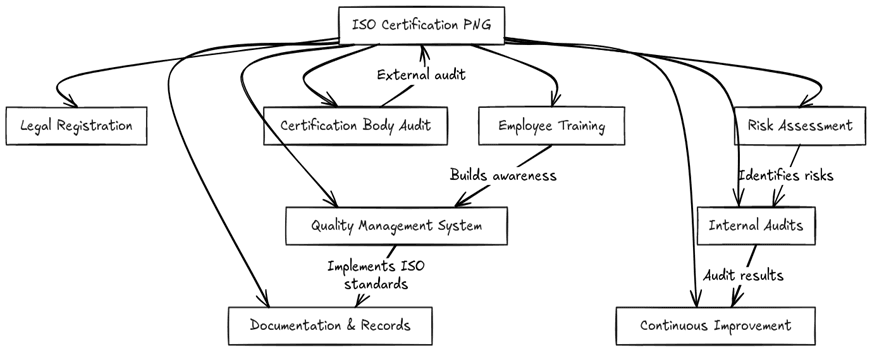
- Leadership commitment, shown through policy, roles, responsibilities and management review
- Defined scope covering sites, services, exclusions and outsourced processes
- Process control for core workflows (purchasing, project delivery, maintenance, transport, camp services, IT operations)
- Risk review and practical controls tied to operational realities, including contractor and supplier risks
- Document and record control, so teams use current versions and retain required evidence
- Competence management, including onboarding, training and task-specific authorisations
- Supplier and contractor controls (evaluation, approval, monitoring and corrective actions)
- Monitoring and measurement through targets, checks, inspections and trend review
- Internal audits completed across the scope, with findings tracked to closure
- Corrective actions with root-cause review, plus follow-up checks to prevent repeat issues
Benefits of ISO Certifications in Papua New Guinea
ISO certifications support buyer confidence because they provide auditable evidence that processes are controlled and reviewed. Below are some of the key benefits:
- Faster vendor approval, because buyers recognise ISO-based controls and records
- More consistent delivery, across shifts, projects and remote sites
- Fewer repeat issues, through corrective action tracking and closure evidence
- Stronger supplier control, through evaluation routines and traceable purchasing records
- Safer work practices, through hazard controls, competence checks and incident learning
- Better environmental control, through waste, spill readiness and chemical handling evidence
- Improved data protection, through access controls, backups and incident response routines
- Clearer onboarding, through role-based training and usable work instructions
- Better food safety assurance, through hygiene monitoring, allergen control and traceability
- Stronger tender readiness, with records that align with buyer checklists
To get ISO certified for your operations, reach out to our team at support@pacificcert.com.
Market trends and industry outlook
Growth forecasts for Papua New Guinea are commonly presented as moderate and closely linked to resource output, project cycles and infrastructure activity. ADB’s published outlook points to growth around 4.2%, with moderation around 3.8% thereafter.
Trade composition also signals where buyer checks are strongest. With exports led by petroleum gas, gold and copper ore (multi-billion-dollar categories), supplier expectations around quality controls, HSE routines and environmental practices tend to tighten in the resource-linked supply chain, including logistics, maintenance and project delivery services.
Digital infrastructure investment is another trend that increases demand for ISO/IEC 27001, especially for telecoms, IT providers and organisations handling customer and payment data. Reuters has reported a US$ 120 million Australia-funded initiative for subsea cables to strengthen digital connectivity in Papua New Guinea, highlighting the direction of investment and the related focus on digital security and resilience.
Challenges faced in Papua New Guinea
Organisations often face practical constraints that make consistency harder across sites, shifts and subcontractors. A common issue is record discipline during busy periods: work may be completed properly, but evidence is missing (inspection logs, permit records, toolbox talk attendance, equipment checks, handover notes, or supplier approvals). During audits and buyer reviews, missing records become the difference between “done” and “proven.”
Contractor and subcontractor control is another recurring challenge, especially on construction and maintenance sites, transport operations and camp services. Different vendors may follow different work methods, PPE routines, incident reporting habits and supervision standards. ISO systems expect clear rules for contractor selection, induction, supervision and performance review; without this, gaps show up as inconsistent permits, incomplete checklists, unclear responsibilities and repeat incidents.
Finally, some organisations write procedures that do not match real work. When documents feel generic, teams stop using them. Better results come from writing procedures around real job steps, then updating them through internal audit findings and corrective action trends.
Cost of ISO certifications in Papua New Guinea
ISO certification cost depends on the standard, scope, number of sites, headcount and process complexity. Multi-site audits usually require more audit time because evidence must be checked across locations. Higher-risk scopes, such as field services, construction and food operations, can also increase audit time due to the nature of controls that must be verified.
For a free customised quote for your organisation, contact us at support@pacificcert.com.
Timeline for ISO certification in Papua New Guinea
Timelines depend on scope readiness and how quickly controls can be applied across teams. Smaller organisations with a clear scope and stable routines often complete certification in a few months. Mid-sized organisations usually take longer because training, internal audits and corrective action closure require coordination across departments. Multi-site scopes can take additional time since consistent implementation must be shown across locations during Stage-2.
How Pacific Certifications can help?
Pacific Certifications is an independent ABIS-accredited certification body providing third-party certification audits against ISO standards. We support organisations across hospitality, logistics, construction, IT services, food supply and manufacturing support work. Our audit approach follows the scope and sites you operate, while focusing on practical evidence such as records, interviews and on-site verification.
Pacific Certifications provides services including:
- Certification audits for ISO 9001, ISO 14001, ISO 45001, ISO 27001, ISO 22000, ISO 50001 and numerous other standards
- Multi-site certification for organizations operating across multiple locations in Piedmont Sardinia, or regionally
- Industry-specific expertise with auditors experienced in your sector’s unique requirements and challenges
- Surveillance audits conducted annually to verify continued compliance and system effectiveness
- Recertification audits every three years providing comprehensive system reviews
- Expert auditors combining technical standard knowledge with practical business understanding
- International recognition ensuring your certificate is accepted globally for tenders and contracts
Contact Pacific Certifications at support@pacificcert.com or visit www.pacificcert.com to discuss your certification needs and learn how we can support your quality journey.
Training and Courses
Before selecting a course, most organisations align training with job roles and audit readiness, so training stays practical across sites and shifts.
- Lead auditor training: Focuses on audit planning, audit programme management, interviewing techniques, sampling methods, evidence evaluation, nonconformity writing and audit reporting, aligned with ISO audit practice.
- Lead implementer training: Covers how to build, run and maintain a management system that matches real operations, including scope-setting, process mapping, internal audits, management review and corrective action closure.
Pacific Certifications provides accredited training programs. If your organization is looking for ISO training, our team is equipped to help you. Contact us at support@pacificcert.com.
FAQs
Which ISO standards are most requested by buyers in Papua New Guinea?
ISO 9001, ISO 14001, ISO 45001, ISO/IEC 27001 and ISO 22000 are commonly requested
Can small businesses in Papua New Guinea get ISO certified?
Yes, if the scope is clear and records are maintained consistently.
What is the difference between Stage-1 and Stage-2 audits?
Stage-1 checks readiness and documented controls, while Stage-2 checks implementation using site evidence and records.
Do we need an internal audit before the certification audit?
Yes, internal audits are expected before Stage-2.
How long does ISO certification take?
It depends on readiness, scope and number of sites.
What records do auditors usually review first?
Training records, internal audit reports, corrective actions and operational logs
Can multiple ISO standards be audited together?
Yes, through an integrated management system.
How often are surveillance audits carried out?
Typically once each year during the certification cycle.
What usually increases ISO certification cost the most?
More sites, higher headcount and longer audit time are common cost drivers.
Does ISO certification support tenders and vendor approvals?
Yes, many buyers use ISO certification as a supplier screening requirement
Contact Us
If you need support with ISO Certifications in Papua New Guinea, contact us at support@pacificcert.com.
Read More at: Blogs by Pacific Certifications