Introduction
Mexico’s economy is built on automotive and aerospace, electronics and general manufacturing, oil and gas, agrifood and food processing, logistics corridors, construction and public works, tourism and hospitality, plus a fast-moving IT and digital-services layer. Across these sectors, ISO certification in Mexico is now a common filter in supplier approval, export contracts and lender checks. Buyers want to see that quality, safety, environment, food safety, information security and continuity are under control rather than left to assumption.
For plants and factories, ISO certification for manufacturing companies in Mexico, ISO certification for automotive industry in Mexico, ISO certification for aerospace industry in Mexico and ISO certification for electronics manufacturers in Mexico anchor process control and product consistency. ISO 9001 quality management in Mexico, ISO 14001 certification for manufacturing in Mexico and ISO 45001 workplace safety certification in Mexico help teams keep repeatable output, manage emissions and protect workers.
In agrifood, beverage and retail, ISO certification for food industry in Mexico and ISO 22000 food safety certification in Mexico support HACCP, traceability and cold-chain discipline. For resorts, hotels, travel chains and attractions, ISO certification for tourism companies in Mexico and ISO 9001 certification for hotels in Mexico support service quality and safety promises. Banks, fintech and IT services look at ISO 27001 information security in Mexico and continuity controls when customer and regulator questions sharpen.
If you want to get ISO certified in Mexico, share your scope and sites with Pacific Certifications and we will map accreditation coverage, recommended audit days and Stage-1 and Stage-2 windows that fit your production plan, shutdowns, export seasons and tourism peaks while keeping affordable ISO certification in Mexico and realistic audit logistics in view.
Economic context and industry overview
Mexico links North and Latin American supply chains. Automotive, aerospace, electronics, metalworking and plastics anchor export-oriented manufacturing, supported by clusters near key borders and ports. Oil, gas and power assets and a growing renewable-energy layer keep large users focused on energy performance and risk control. Agrifood and food processing, beverage plants, cold-chain logistics and retail support both domestic demand and exports.
Tourism, hospitality and services bring steady inflows into coastal resorts, city hotels and travel routes. Construction and public works, logistics corridors, warehouses and intermodal hubs expand around industrial regions and ports. Banks, payment services, fintech, shared-service centers and IT firms add digital-economy weight.
Across this mix, buyers and regulators increasingly look for ISO 9001 quality management in Mexico, ISO 14001 for environmental control, ISO 45001 for safety, ISO 22000 for food chains and ISO 27001 for data-driven services when they decide which partners to trust.
Why ISO certifications matter in Mexico?
Large buyers, lenders and public bodies want hard evidence in the form of records and audits, not only policies and presentations. ISO certification benefits for companies in Mexico include cleaner vendor onboarding, fewer disputes about product quality or service outages and clearer answers when customers ask how risks are managed.
ISO 9001 quality management in Mexico supports process mapping, control plans, supplier oversight and change-control in automotive plants, aerospace shops, electronics lines, metalworking, general manufacturing and service centers and ISO 14001 certification for manufacturing in Mexico adds structured control of emissions, waste, noise and resource use. Lastly, ISO 45001 workplace safety certification in Mexico supports hazard identification, site rules, training and investigation of incidents for plants, construction sites, terminals and logistics yards.
ISO certification for food industry in Mexico and ISO 22000 food safety certification in Mexico structure HACCP studies, CCP logs, allergen control, supplier checks and cleaning routines for processors, cold-chains, hotels and restaurant groups. ISO 27001 information security in Mexico and ISO 22301 continuity help banks, fintech, payment gateways, cloud and shared-service platforms show that data and uptime are treated as critical assets.
Popular ISO standards in Mexico
| Industry focus | Commonly requested standards | Why they matter |
| Automotive, aerospace and electronics manufacturing | ISO 9001, ISO 14001, ISO 45001 | Product consistency, site safety, emissions and waste control |
| General manufacturing and industrial suppliers | ISO 9001, ISO 14001, ISO 45001 | Stable production, equipment care, worker protection |
| Food and beverage, agrifood and retail | ISO 22000, ISO 9001, ISO 14001 | HACCP, traceability, food safety and environment |
| Tourism, hotels and hospitality | ISO 9001, ISO 22000 | Guest experience, service reliability, kitchen hygiene |
| Construction, infrastructure and logistics | ISO 9001, ISO 14001, ISO 45001, ISO 22301 | Project work, EHS on sites, continuity for key routes |
| Banks, fintech, IT and shared services | ISO 27001, ISO 22301, ISO 9001 | Information-security control, continuity, service quality |
These patterns reflect the top ISO standards in Mexico that appear most often in RFQs, supplier manuals and partner due-diligence packs.
ISO certification process in Mexico
The ISO certification process in Mexico should start from how work actually runs today in plants, warehouses, kitchens, offices, data rooms and project sites. The aim is to make your ISO system auditable without forcing people to maintain a second, paper-only way of working. For organizations asking how to get ISO certified in Mexico, the steps below are a practical roadmap:
- List products, services, sites, headcount and high-risk processes so your ISO certification process in Mexico has a clear scope and realistic audit time.
- Map processes end-to-end so handoffs, records and responsibilities are visible from suppliers through production, logistics, service delivery and customer contact.
- Set policy and measurable objectives for quality, environment, health and safety, food safety or information security that reflect customer needs, legal duties and business-risk topics.
- Build controlled procedures, work instructions and forms that match practice in plants, warehouses, kitchens, offices and IT environments instead of copying generic templates.
- Train process owners and internal auditors, keep competence matrices and training records for roles that affect product quality, site safety, food safety, environment or data protection.
- Run internal audits that focus on high-risk activities and key suppliers, record nonconformities, agree causes and actions and verify that those actions work in daily use.
- Hold management review with KPIs, audit results, incidents and complaints, resource issues, planned changes and decisions recorded with owners and due dates.
- Schedule Stage-1 for readiness checks and Stage-2 for implementation verification, agree how much work will be on-site and how much remote and align multi-site sampling to risk and geography.
- Keep permits, licenses, inspection reports, customer and regulator letters, monitoring and lab results, maintenance and calibration records and risk logs organized so evidence can be found quickly.
What are the requirements of ISO certifications in Mexico?
ISO certification requirements in Mexico should mirror how work runs in automotive lines, aerospace cells, electronics plants, general factories, agrifood and beverage sites, cold-chain warehouses, hotels and kitchens, construction sites and data rooms so records can stand up in audits and buyer visits. Below are the key requirements:
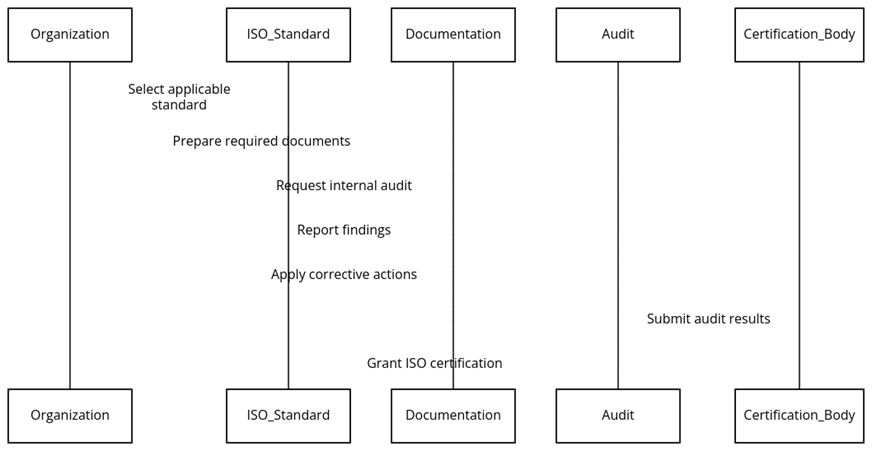
- Scope aligned to products or services, processes and sites, including multi-site programs where plants, depots, branches or service locations share one system.
- Controlled documents and records that match practice, with clear ownership, approval, version-control and change-history so users and auditors can follow what changed and why.
- Risk assessment with operational controls for real hazards such as machine-safety, contractor work, transport and lifting, spills and emissions, noise, food contamination, allergen contact, cyber threats, privacy and continuity of critical processes.
- Standard-specific artifacts such as HACCP plans and CCP logs for ISO 22000, hazard registers and permit-to-work records for ISO 45001, aspect–impact registers and environmental objectives for ISO 14001 and information-asset registers, risk treatment plans and Statement of Applicability for ISO 27001.
- Internal audits and management reviews completed on schedule, with nonconformities, actions and follow-up results recorded in a way that makes effectiveness easy to test in certification and surveillance audits.
What are the benefits of ISO certifications in Mexico?
If you use ISO certification in Mexico as a management tool rather than only a badge, it can support tenders and vendor portals, reassure group headquarters and lenders and keep work steady across seasons, product launches and project cycles. Below are the key benefits:
- Faster pre-qualification in buyer portals and framework agreements for automotive and aerospace, electronics, general manufacturing, food and beverage, logistics, construction, tourism and services.
- Fewer incidents, defects and stoppages on lines, in plants, on sites, in kitchens and on transport routes, which lowers rework, downtime and complaint or claim costs.
- Clear roles, responsibilities and skill paths for operators, technicians, engineers, drivers, HSE staff, food handlers, IT teams and managers across shifts and locations.
- Measured gains in energy use, waste, emissions, uptime and yield where ISO 14001 and related programs are part of the system.
- Stronger signals of reliability and discipline when customers compare suppliers and look at top ISO standards in Mexico as a basic filter.
Near-shoring and regional supply-chain shifts are bringing more attention to ISO certification for manufacturing companies in Mexico and ISO certification for electronics manufacturers in Mexico, often with integrated ISO 9001, ISO 14001 and ISO 45001 sets for plants and suppliers.
Food processors, beverage plants, cold-chains and retailers see rising demand for ISO certification for food industry in Mexico and ISO 22000 food safety certification in Mexico as export partners and brands ask deeper questions about HACCP and traceability. Tourism and hospitality operators are using ISO certification for tourism companies in Mexico and ISO 9001 certification for hotels in Mexico to stand out in crowded resort and city markets. Banks, fintechs and IT service providers focus on ISO 27001 information security in Mexico and continuity controls as digital channels carry more of their business.
Challenges faced in Mexico
Demand and expectations keep rising and some organizations find it tough to keep ISO work moving at the right pace. Typical challenges include:
- Budgeting time and funds for certification and system upkeep while dealing with production peaks, project deadlines, export cycles and travel logistics.
- Pockets of “paper-only” ISO where procedures exist but teams still rely on habit, which creates mismatches during audits and buyer visits.
- Limited numbers of trained internal auditors and process owners who can join ISO clauses with real risks in plants, sites, chains and platforms.
- Gaps in document-control, internal audits, corrective-action discipline and record-keeping across multi-site and multi-vendor networks.
- Confusion between professional ISO consultants in Mexico, who support implementation, and accredited certification bodies that provide independent audits and certificates.
What is the cost of certification in Mexico?
ISO certification cost in Mexico is confirmed after scoping and depends on headcount and risk, the number and spread of sites, the standards you choose, whether the program is single-standard or integrated, sampling depth for plants, depots, warehouses, hotels, offices and data rooms and the mix between on-site and remote audit work.
For many small to medium enterprises in Mexico, cost for ISO 9001 certification in Mexico City or other regions depends more on employee numbers, process complexity and single-site versus multi-site scope than on revenue. The same pattern applies when you add ISO 14001, ISO 45001, ISO 22000 or ISO 27001. Affordable ISO certification in Mexico usually comes from realistic scope and good preparation, not from cutting audit time below what rules allow.
Your proposal from Pacific Certifications will itemize Stage-1, Stage-2 and surveillance days, explain on-site versus remote activities and highlight any efficiencies for multi-site or integrated systems so leadership and finance teams can plan clearly. To discuss ISO certification cost in Mexico and get a free estimate for ISO 9001, ISO 14001, ISO 45001, ISO 22000 or ISO 27001, contact support@pacificcert.com.
What is the timeline for certification in Mexico?
Timelines depend on document and record readiness, how quickly Stage-1 findings are closed, single versus multi-site scope and whether your ISO certification process in Mexico covers one standard or several together. Planning around production peaks, shutdowns, export seasons, big deployments and customer audits is important.
A prepared single site such as one plant, depot, warehouse, hotel, office, lab or data room can often move from application to decision within a single certification cycle once records, internal audits and management review are in place. Multi-site or integrated programs, especially where plants and offices sit in different regions, need more sampling and coordination time.
Important standards often requested by buyers in Mexico
| Standard | Typical drivers in Mexico |
| ISO 9001 | Supplier approval for automotive, aerospace, electronics, general manufacturing, logistics and services |
| ISO 14001 and ISO 45001 | Environmental and safety control for plants, depots, yards, terminals and sites |
| ISO 22000 | Food safety and HACCP for agrifood, beverage, hospitality, retail and cold-chains |
| ISO 27001 and ISO 22301 | Information-security and continuity for banks, fintech, IT, cloud and shared-services |
These sets reflect the ISO certification requirements in Mexico that appear most often in customer and regulator expectations.
How Pacific Certifications can help?
Pacific Certifications audits and certifies ISO management systems for automotive and aerospace suppliers, electronics and general manufacturing firms, agrifood and beverage plants, logistics and warehouse operations, construction and infrastructure contractors, tourism and hospitality chains, banks and fintech, IT and shared-service centers across Mexico. We provide independent ISO certification and audit services under recognized accreditation with clear pricing and a team used to plant-floor, site, kitchen and data-room realities.
Many organizations work with the best ISO certification consultants in Mexico or professional ISO consultants in Mexico for implementation, while Pacific Certifications acts as the independent certification body. If you plan to get ISO certified in Mexico with ISO 9001, ISO 14001, ISO 45001, ISO 22000, ISO 27001 or integrated systems, request your ISO audit plan and fee estimate from support@pacificcert.com.
Accredited training programs
Pacific Certifications also supports organizations in Mexico through accredited training programs:
- Lead auditor training: For professionals who audit ISO 9001, ISO 14001, ISO 45001, ISO 22000 or ISO 27001 in manufacturing, food, logistics, construction, tourism or services.
- Lead implementer training: For personnel who build or improve ISO systems inside plants, warehouses, hotels, kitchens, offices and digital environments.
These programs can run online or on-site, depending on client needs, and help teams build internal capability so certification remains under their control.
FAQs
How long does ISO certification take in Mexico?
A prepared single site can usually complete the initial ISO certification cycle within one round of audits, while multi-site or integrated programs take longer.
Which industries in Mexico need ISO certification most?
Automotive and aerospace, electronics and general manufacturing, agrifood and beverage, logistics, construction, tourism and hospitality, banks, fintech and IT services see the highest demand.
Can ISO audits in Mexico be partly remote?
Yes, many interviews and document reviews can be done remotely, with focused on-site visits for higher-risk areas
Which ISO standards suit manufacturing companies in Mexico?
Most plants start with ISO 9001, then add ISO 14001 and ISO 45001 where environmental and safety risks are significant.
What fits food and beverage companies in Mexico?
ISO certification for food industry in Mexico usually combines ISO 22000 for food safety with ISO 9001 and sometimes ISO 14001 where environmental topics are important.
How does ISO 27001 help banks and fintech in Mexico?
ISO 27001 information security in Mexico supports structured control of customer data, transactions, platforms and interfaces with partners.
Do small and mid-sized firms in Mexico also get ISO certified?
Yes, many small and medium enterprises use ISO certification to enter new supply chains and support exports.
What is the first step if we want to get ISO certified in Mexico?
Define your scope, map key processes, identify main risks and start building controlled documents and records that match real work.
Are ISO certificates from Mexico accepted by international buyers?
Accredited ISO certificates are widely accepted, subject to each buyer’s normal supplier-approval process.
How do we keep our ISO certificate valid in Mexico?
Keep internal audits and management reviews on schedule, close nonconformities and complete surveillance and recertification audits when due.
Contact Us
If you need support with ISO certification in Mexico, contact us at support@pacificcert.com.
Read More at: Blogs by Pacific Certifications